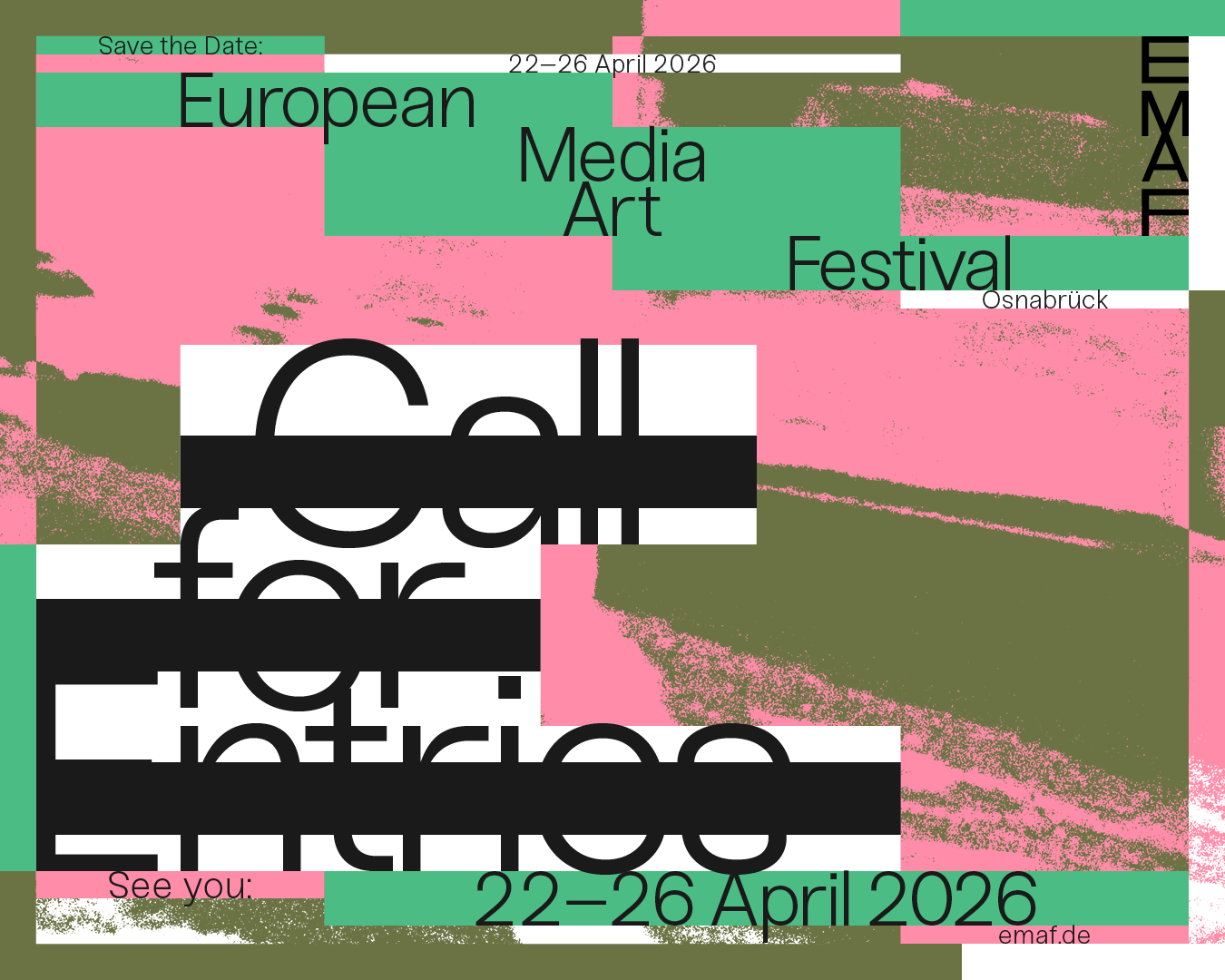
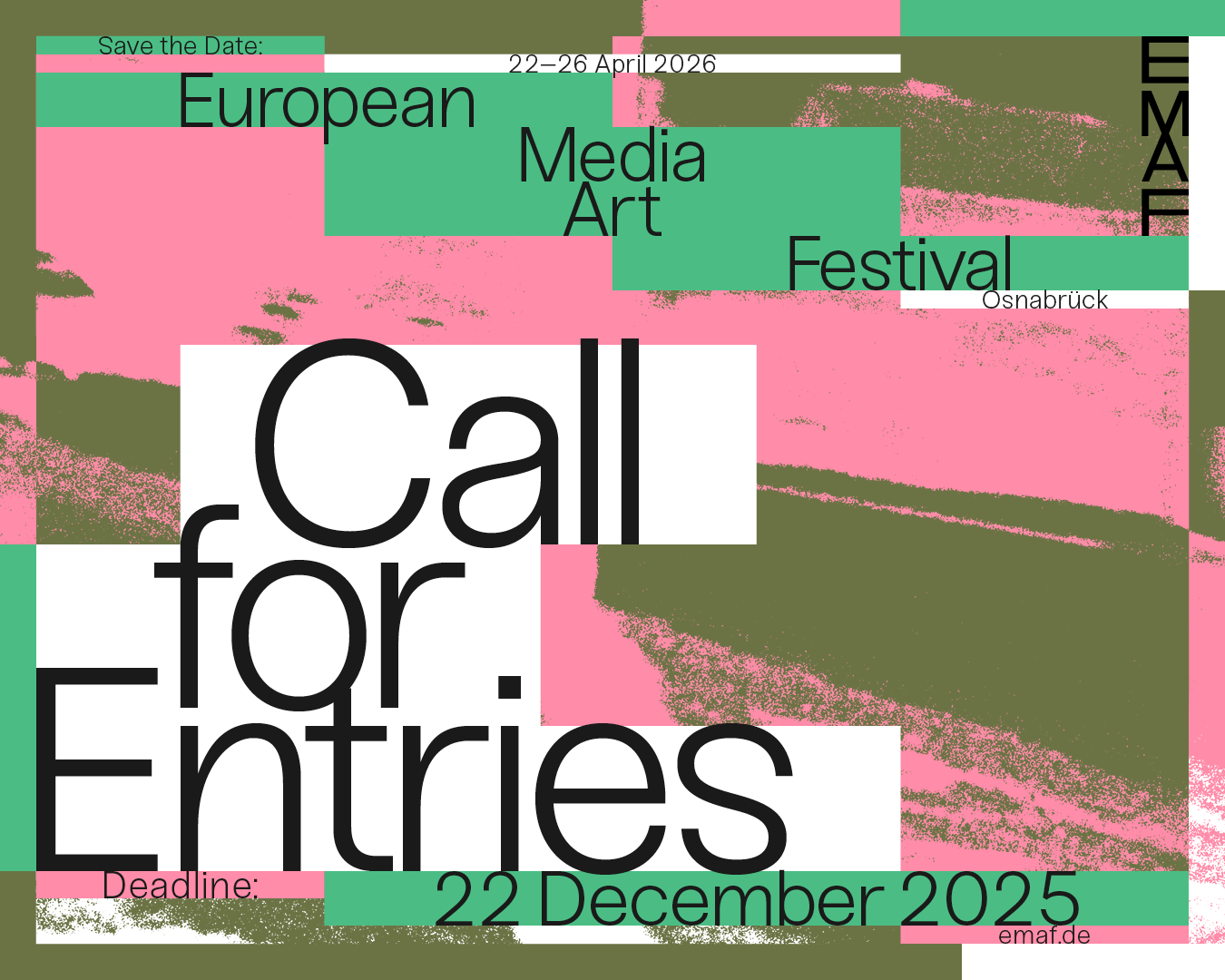
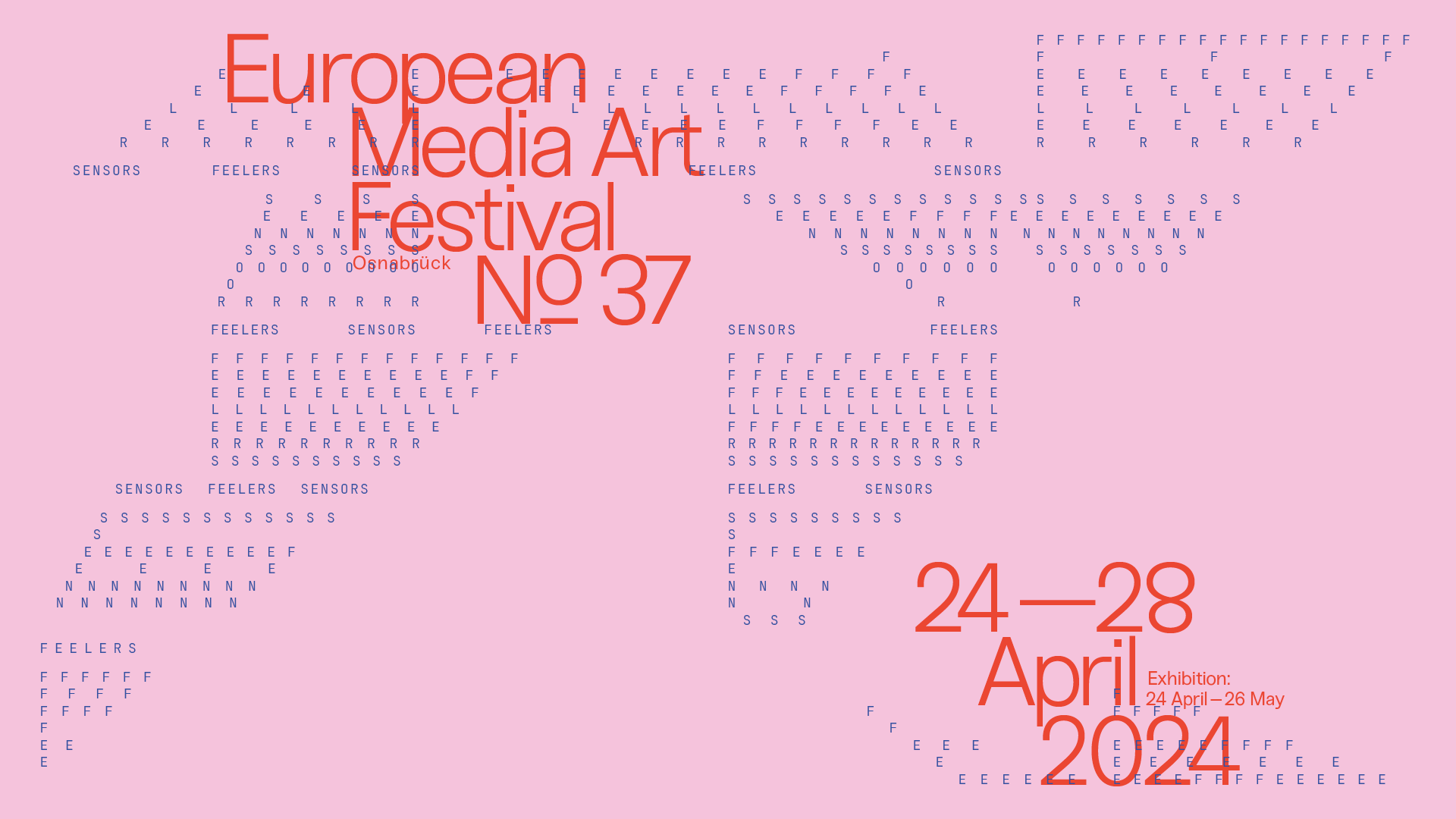
21 - 25 April 2027 ↳ Festival 21 April - 23 May 2027 ↳ Exhibition
We look forward to receiving your entries for EMAF 2027!
Starting now, recent works for the sections Film, Installation and Expanded can be entered here for EMAF 2027.
Please note the following change:
The call for entries will close as soon as 2,200 entries have been received, or the latest on 15 December 2026.
Please find further information in our Regulations.
News
09/03/2026EMAF 40 - Call for Entries
We look forward to receiving your entries for EMAF 2027!
Starting now, recent works for the sections Film, Installation and Expanded can be entered here for EMAF 2027.
Please note the following change:
The call for entries will close as soon as 2,200 entries have been received, or the latest on 15 December 2026.
This is in response to the significant increase in entries in recent years. We are very pleased by this growing interest in the festival. However, it is also important to us that we are able to devote the necessary time and attention to all works and projects entered during the viewing process. For this reason, we have decided to limit the number of entries.
Entries will continue to be free of charge.
Below is a brief overview of the sections:
FILM
Experimental films of any length and on any subject
From these, we will select entries for the International Selection (short and medium-length films) and the Features section. Films must have been completed no earlier than 2026. There is no requirement for a premiere.
INSTALLATION
Installative, interactive, site-specific, or sculptural media artworks
Contributions to the exhibition will be selected from these entries. They must have been completed no earlier than 2026 and must relate to the theme of the 2027 festival. The focus is on the archive as an instrument of knowledge production, a site of critical intervention, and a space for alternative visions of the future.
EXPANDED
Performances, live events, or workshops
Entries in this category will be considered for inclusion in either the performance programme or the talks & workshops programme, depending on their concept and thematic focus.
Further information on entries and the selection process can be found in our Regulations.
07/20/2026EMAF Call - Exhibition curator
For the upcoming 40th edition of the festival, we are looking for a curator for the EMAF exhibition, which will take place at Kunsthalle Osnabrück from 21 April – 23 May 2027.
Period of work: October 2026 – May 2027
Application deadline: 4 September 2026
EMAF is regarded internationally as one of the most important forums for media art. Consisting of an exhibition, film programmes, talks, workshops and performative formats, the festival links contemporary artistic practices with social discourses. Guest-curated projects and retrospectives also offer an in-depth look at historical positions and contexts.
The EMAF exhibition opens along with the five-day festival. This group exhibition features current works of media art and is curated in line with the festival’s annual theme.
EMAF’s 2027 theme focuses on the archive as an instrument for the production of knowledge, as a site of critical intervention and as a space for imagining alternative futures. Taking these ideas as a starting point, the curator will both develop a conceptual framework for the exhibition and be responsible for its implementation.
We are seeking a curator with at least five years of experience in curating and producing media art exhibitions or comparable projects.
The key tasks here include:
Developing a conceptual framework for the exhibition and selecting the pieces to be included in it
Reviewing submissions received via the open call and independently researching other possible works for the exhibition
Planning and producing the exhibition in collaboration with the festival management and the on-site technical team
Managing the budget and assisting with the acquisition of third-party funding
Writing the necessary texts and sourcing/researching images for the festival publications and press materials
Training exhibition guides and supervisors
The curator is required to be in Osnabrück both during the festival and installation/ deinstallation periods, but may otherwise work remotely.
Excellent German and English language skills are essential.
We offer:
A flat fee of €10,000 (plus VAT)
Travel and accommodation expenses during the festival and the installation/ deinstallation periods
The opportunity to collaborate with an international curatorial team
Flexible working hours
We expect applicants to respect the dignity and safety of all individuals, to ensure that everyone is treated equally and to take a firm stand against sexual harassment and discrimination of any kind.
We welcome all applications—regardless of gender, nationality, ethnic and social background, religion/beliefs, disability, age, or sexual orientation and identity.
We look forward to receiving a detailed CV and a portfolio including work samples by 4 September 2026 at the following email address: bewerbung@emaf.de.
Please contact Katrin Mundt at kmundt@emaf.de with any questions you might have.
05/26/2026Panel Artistic freedom and institutional responsibility on 15 June
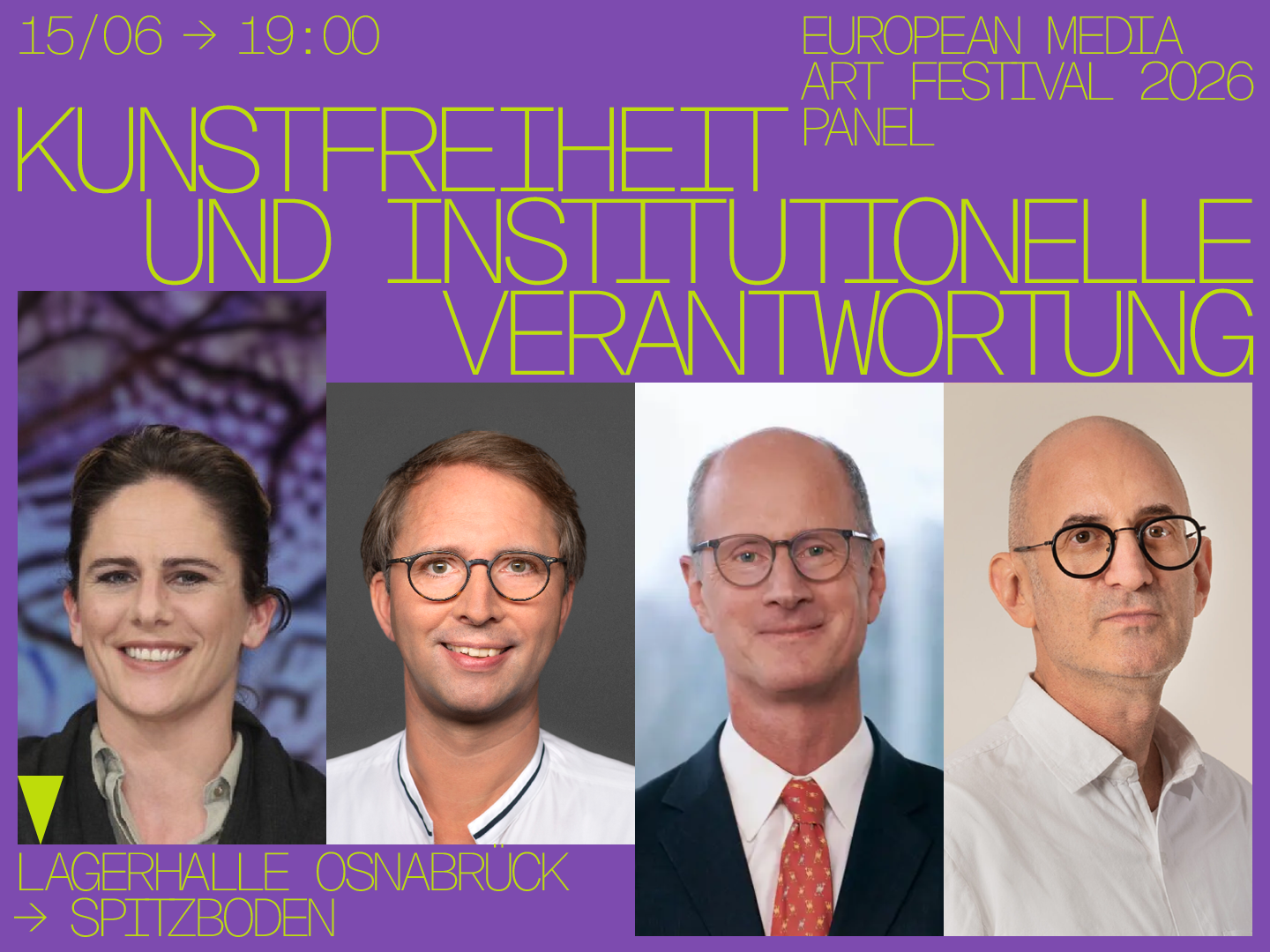
We are delighted to invite you to our panel discussion on ‘Artistic Freedom and Institutional Responsibility’.
Public funding for the arts and culture has given rise to an extraordinarily diverse cultural landscape in Germany. However, cultural practitioners and institutions are vulnerable to politically motivated interference in funding allocation processes due to their existential dependence on funding. Recent controversies surrounding the Berlinale, the German Bookstore Award, and the Düsseldorf Art Academy have clearly demonstrated that this repeatedly threatens the freedom of art, science, and speech. Most recently, the EMAF was criticised for inviting a Palestinian artist, prompting its two main sponsors, the City of Osnabrück and the State of Lower Saxony, to publicly distance themselves from the festival.
We would like to examine these controversies and their political and legal contexts in greater detail with experts and members of the public.
What creative freedoms of expression can art institutions claim for their programme content, particularly when it concerns Israel/Palestine or protagonists from the region? Where should the limits be set? What responsibility do funders and recipients hold in providing space for critical and controversial topics? What can funders demand in this context? What must those receiving funding deliver?
The panel (in German)
Kunstfreiheit und institutionelle Verantwortung (Artistic freedom and institutional responsibility).
A panel discussion following EMAF 2026
will take place on
Monday, 15 June at 7 pm at the Lagerhalle (Spitzboden).
Admission is free.
We warmly invite you to attend the panel discussion and join in the discussion!
05/05/2026International Museum Day - Workshop by Alternative Monument collective
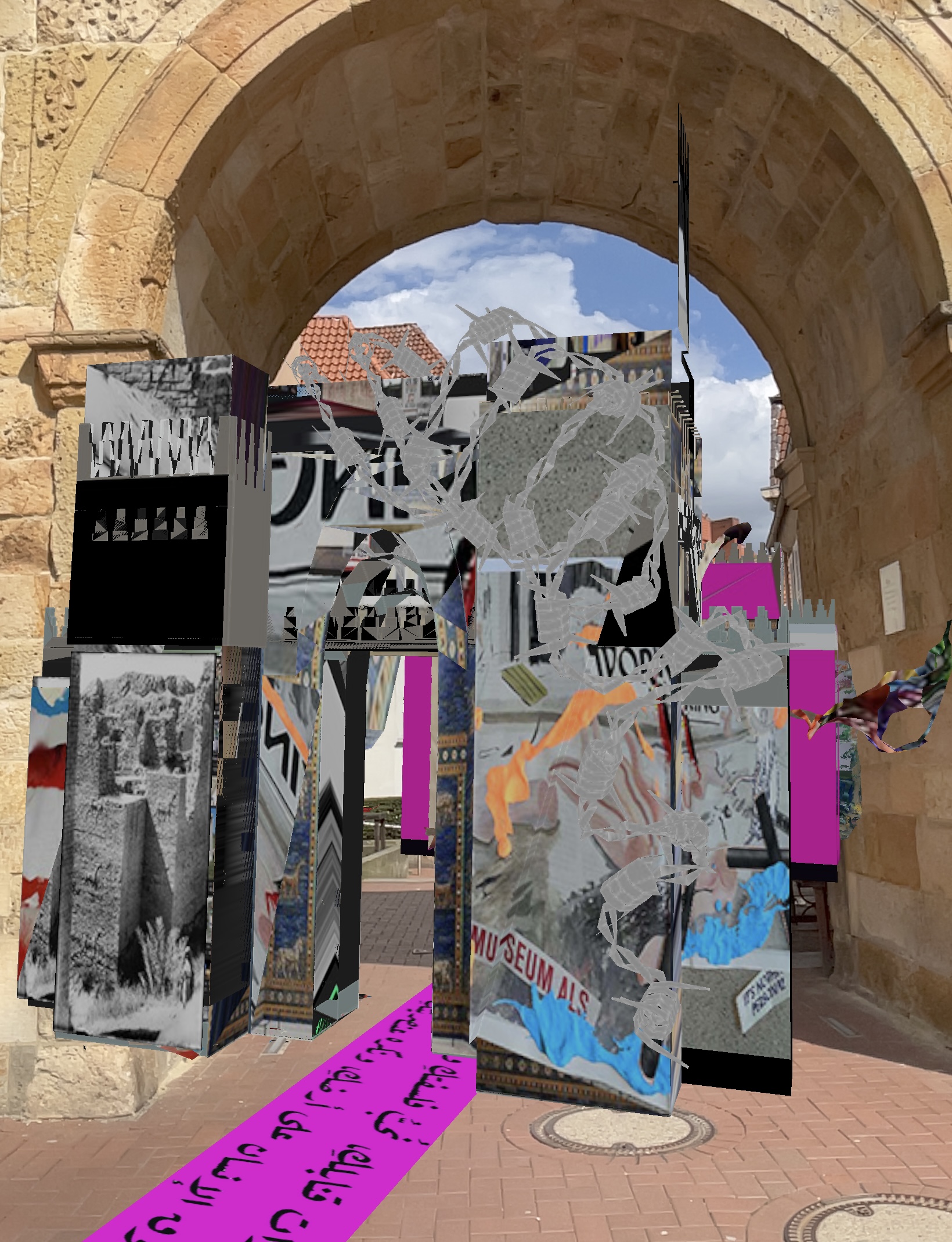
Conceived by the Alternative Monument collective, the ALTERNATIVES DENKMAL FÜR DEUTSCHLAND (ADfD, DE 2025, 00:20:00) shifts intuitional remembrance into the public and digital realm. Set up as an augmented reality project, memory is activated here in situational fashion via mobile devices, whereby visual fragments are corrected to narratives of migration, exile and displacement. Memory can be appears as a polyphonic process that resists any final fixed form.
On International Museum Day on 17 May from 12:00 to 16:00, the European Media Art Festival is hosting a workshop by the Alternative Monument collective in the new building of the Kunsthalle Osnabrück.
Rooted in the urgent need to counter the toxic discourse on migration in Germany, the workshop frames migration as a force of connection rather than division. Together with the participants, the artists’ collective explores how artistic ideas survive restriction, lack of resources, and structural limits using Osnabrück’s public space as a playground. Its monuments and sculptures become raw material for the workshop. The workshop explores how the existing can be rewritten, reclaimed or reimagined by allowing the city’s visible and invisible boundaries, stories and silences to shape our collective making and unmaking.
The number of participants is limited. Please register at presse@emaf.de.
Picture Copyright: Alternative Monument collective
04/26/2026EMAF 39 - Award Ceremony and Thank you!
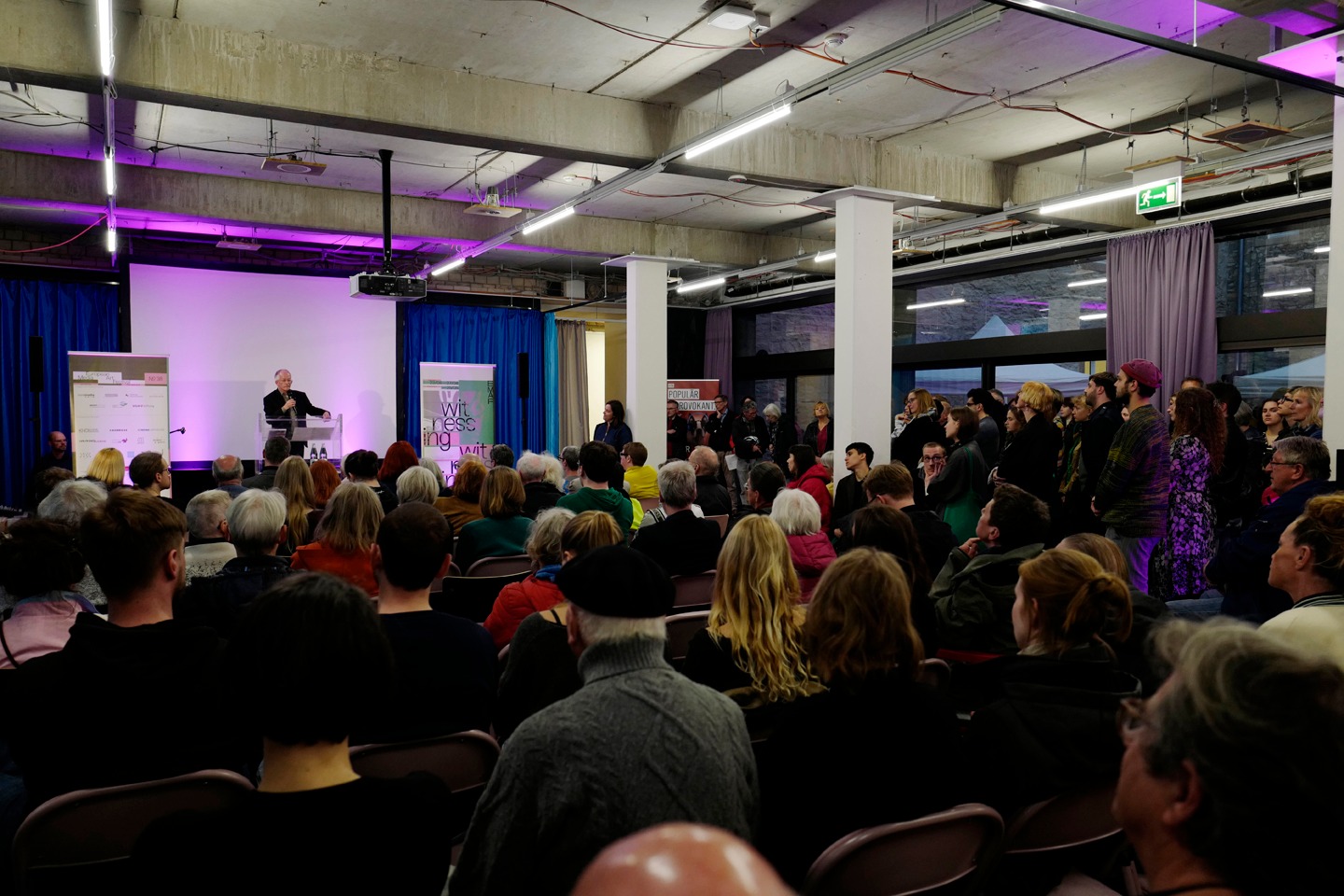
Yesterday, the 39th European Media Art Festival came to a close in Osnabrück after five days. We are delighted by the enormous interest shown in all of the screenings, exhibitions, talks, and guided tours. Around 1,000 people attended the opening alone.
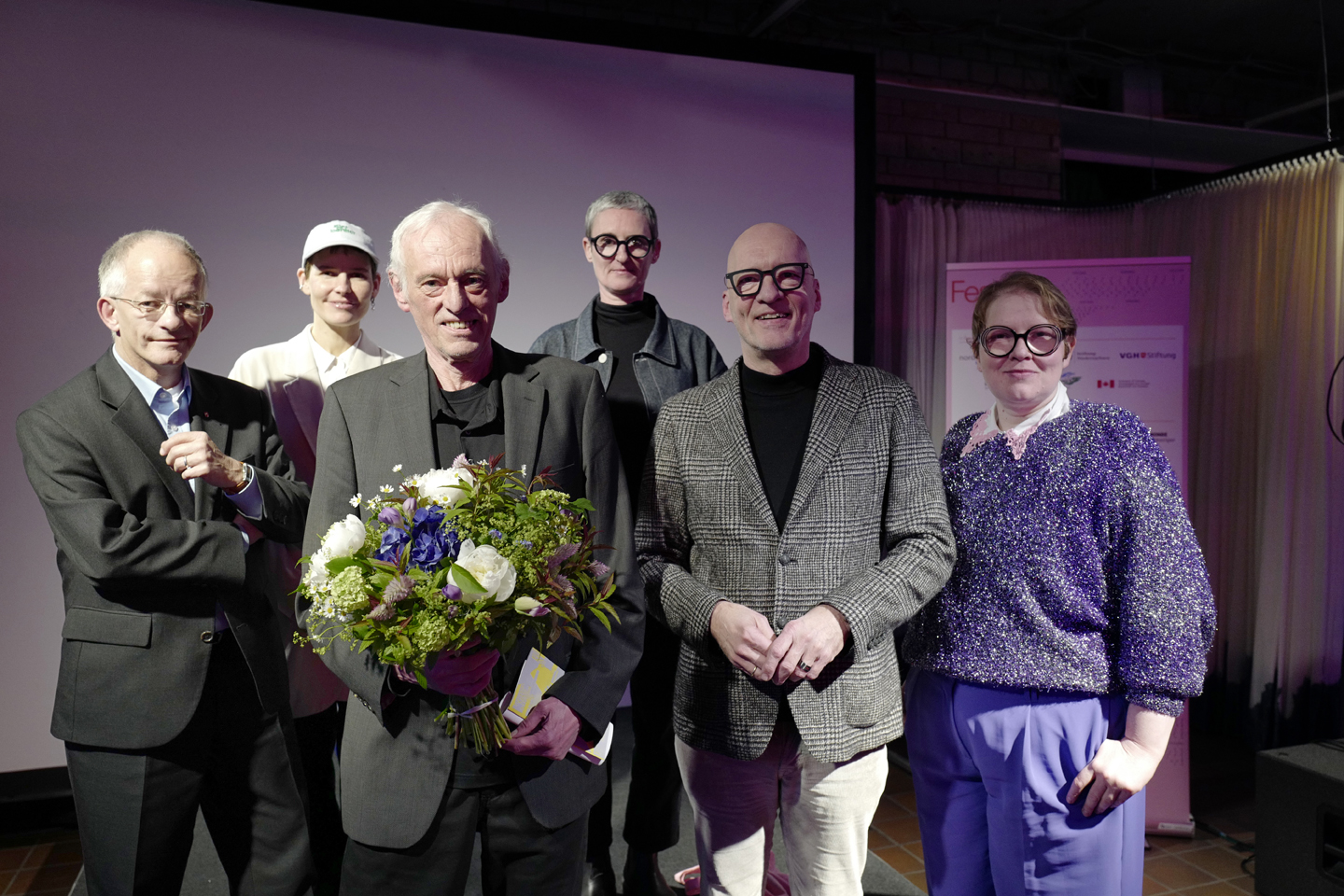
On Sunday morning, the EMAF Media Art Prize, awarded by the Association of German Film Critics (VdFk), was presented at the festival. José Jiménez won the award for LENGUA MUERTA / DEAD TONGUE (CL 2025, 00:24:50), which celebrated its German premiere in Osnabrück. The film recounts the story of Ricardo Rifo, who in 1980 was trained as a dog handler by Ingrid Olderöck, the most powerful woman in the secret police during the Chilean dictatorship. Four decades later, the farmer wanders through an inhospitable and devastated landscape, tormented by his inability to put the horror into words.
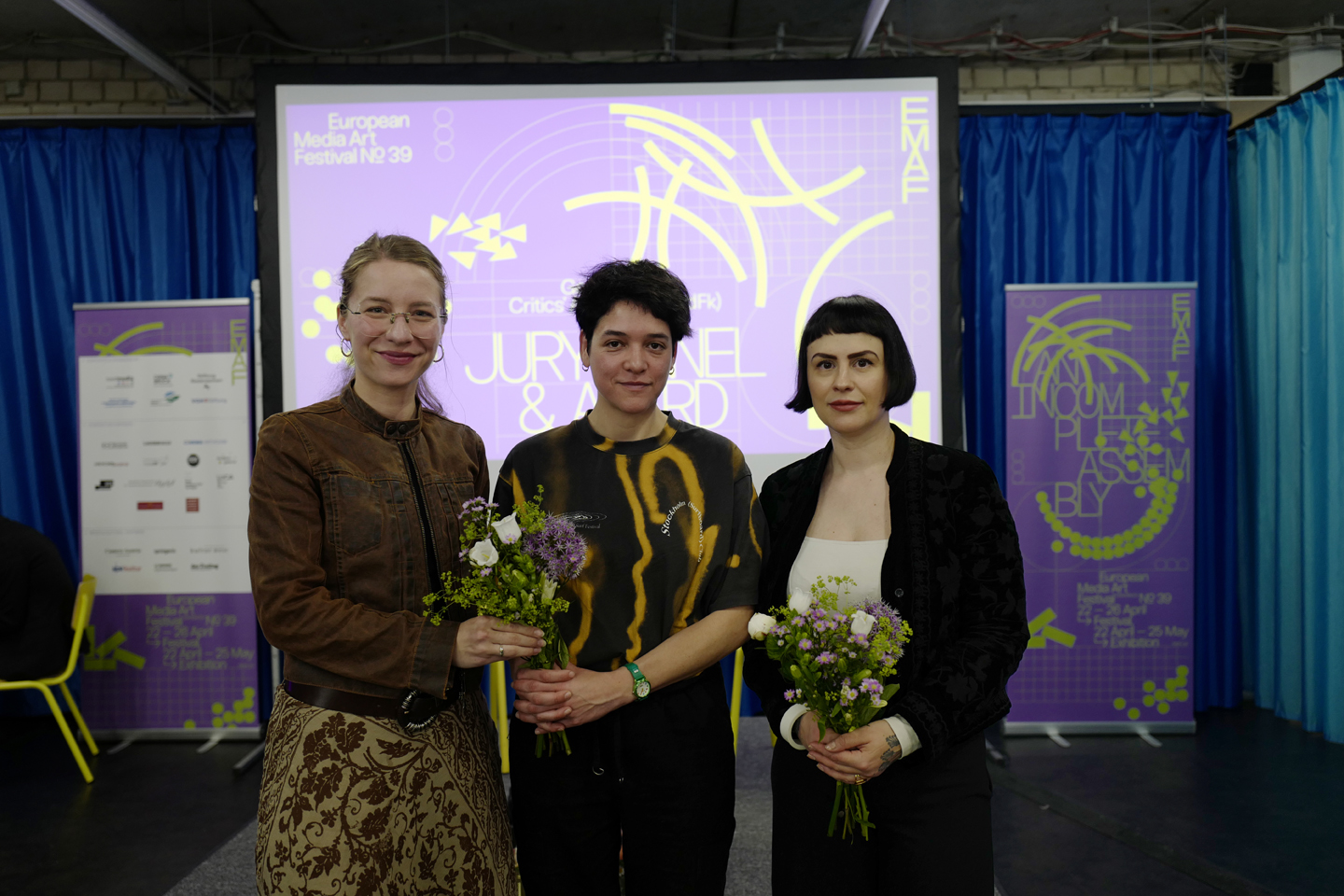
This year’s jury of the German Film Critics’ Association consisted of Masha Matzke, Ursula von Keitz and Maja Roth. In their statement, they explained:
“I want to tell you something, but I can’t” is not a sentence without implications. Against the backdrop of a rugged coastal landscape bathed in twilight, a lone hiker accompanied by six dogs comes into view. On his journey to retrieve memories of the past, the hiker’s face remains turned away, his voice consistently separated from his body. LENGUA MUERTA / DEAD TONGUE by José Jiménez translates the as-yet-unspeakable into cinematic form. The fragmentary nature of his memory is skilfully combined with a black-and-white aesthetic of rupture and absence.
Matías Illanes’s camera guides us through densely textured shots of nature, through impenetrable thickets and barren wastelands, and through a ravaged landscape into which the cruelty of the Pinochet dictatorship remains indelibly imprinted. The violent impact of human intervention becomes palpable in the duration afforded by these shots: cleared forests, ship graveyards, rubble heaps and snarling dogs. Image, voice and sound combine to create a physical presence within the frame of a long, static shot, exploring the traces of violence within the subject matter while also projecting them onto the coarse, rough materiality of the filmic surface.
The jury awarded an honourable mention to Maryam Tafakory for DARIA´S NIGHT FLOWERS (IR, GB, FR, 2025, 16:00), which also celebrated its German premiere at the EMAF. The film tells the story of Daria, who has written her first manuscript in which she recounts her love for a mysterious girl named “Abi” [Blue]. According to the synopsis, the night-blooming flowers in her garden conceal the secrets of a country where love stories have become everyday crime scenes.
The jury notes: “How to depict what is forbidden in official representations? In her sensuous and poetic montage of fragments from Iranian cinema, Maryam Tafakory creates a counter-archive that lays bare the hidden desires of women in Iran, as well as their brutal suppression, sedation and erasure, through the condensation of gestures and glances. The film’s dense, hallucinatory, tender, and tactile texture artfully interweaves the internalisation of violence and censorship with the externalisation of repressed emotions and realities, creating a sensory experience.”
Neither the prize nor the honourable mention comes with a cash award. The reason: since last year, the EMAF has been distributing the prize money equally among all 30 films in the International Selection.
We would like to thank our many visitors, the artists, and the whole team for making the festival such a success!
Special thanks go to our sponsors:
nordmedia,
City of Osnabrück,
Foundation of Lower Saxony,
Felicitas and Werner Egerland Foundation,
Landschaftsverband Osnabrücker Land e.V.,
VGH Foundation
and our cooperation partners:
Kunsthalle Osnabrück,
Lagerhalle e.V.,
Cinema Arthouse,
Haus der Jugend,
Kunstraum hase29,
BBK,
skulptur-galerie,
University of the Arts Bremen,
Karlsruhe University of Arts and Design,
Royal Academy of Art The Hague,
LUCA School of Arts,
University of Osnabrück,
Osnabrück School of Music and Art
as well as our media and cultural partners:
Camera Austria,
Springerin,
kultur.west,
NDR Kultur,
Le Monde diplomatique,
der Freitag
The 40th European Media Art Festival will take place from 21 to 25 April 2027. We look forward to seeing you again!
Picture copyright: Kerstin Hehmann
04/24/2026EMAF 30 - Tips for the weekend
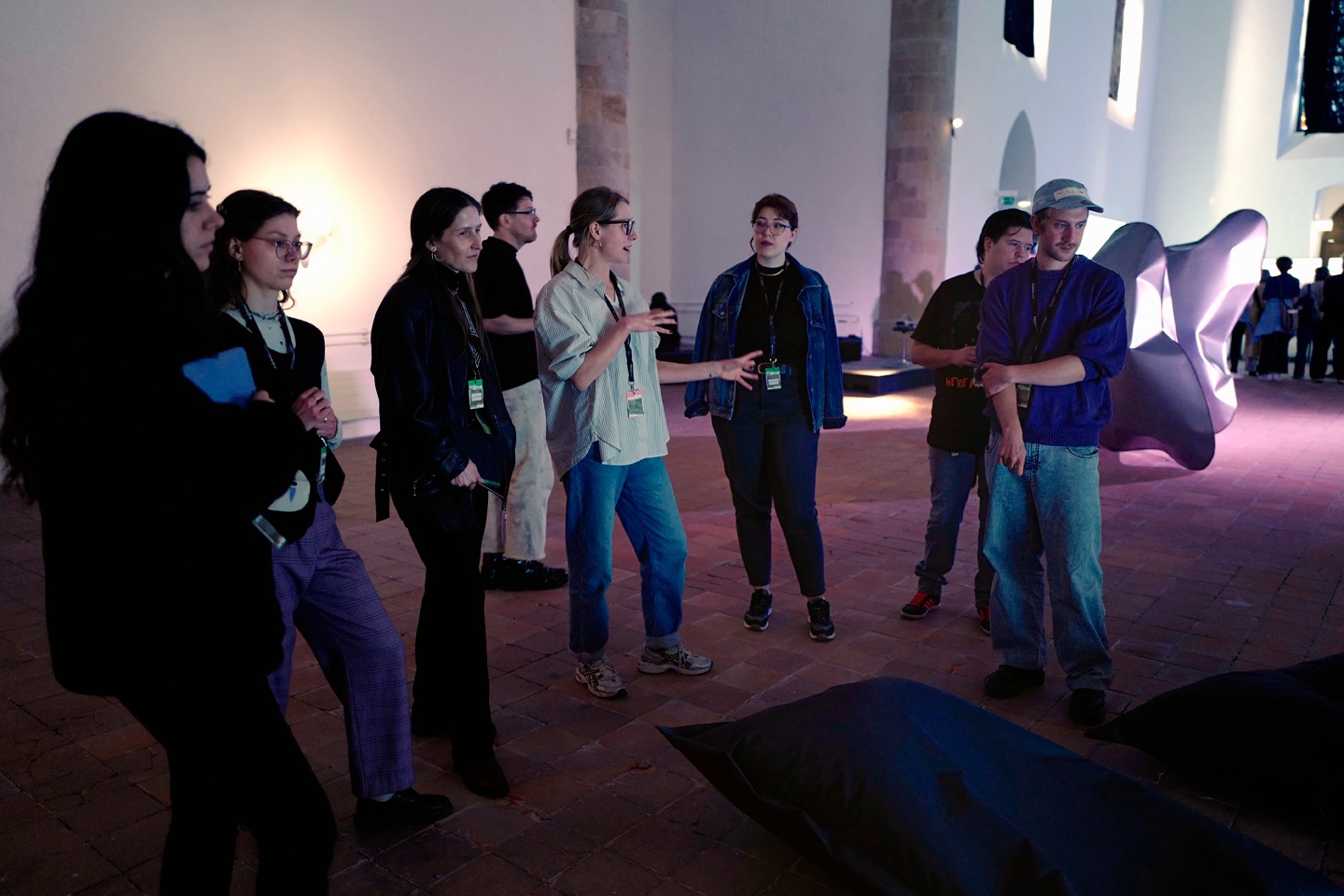
The third day of EMAF has begun. A wide range of interesting events, meetings and discussions have already taken place. For anyone arriving today who’d like to get an overview of the exhibition at the Kunsthalle Osnabrück, there’s a guided tour in English today, in addition to the daily tours. It starts at 15:30 at Kunsthalle Osnabrück.
As part of the International Selection, we will be screening the programme ON COMING DOWN tomorrow. This will be followed by a Q&A with the filmmakers. The films to be screened are “Warnings to the Distant Future” by Stefanie Schroeder and Juliane Jaschnow, “Slowest Smile” by Alee Peoples (a world premiere!), “Make Heaven Crowded” by Steve Reinke and “A Circle as the Centre of the Whole” by Utkarsh. Tomorrow at 11:00 at Lagerhalle.
The EMAF workshop “Alternative Monument: Migrating Memory”, organised by the Alternative Monument collective, explores the need to counter the toxic discourse surrounding migration in Germany. The workshop views migration not as a divisive force, but as a unifying one. How can monuments, gestures and collective narratives emerge within institutional frameworks and yet function as a counter-narrative to them? This is one of the central questions.
The workshop will be held in English; German will also be available upon request. Places are limited, but there are still a few spots available. If you’re interested, simply get in touch at presse@emaf.de. It starts tomorrow at 13:00 at Kunsthalle Osnabrück.
The Association of German Film Critics (VdFK) invites you to a jury panel and the presentation of the VdFK Media Art Award on Sunday at 11:00. The Association’s jurors – Masha Matzke, Maja Roth and Ursula von Keitz – will discuss the films in the International Selection and then present their award. Following the screening of the award-winning film, we cordially invite all attendees to enjoy some snacks and drinks.
At 15:30, there will be another opportunity to take part in a guided tour at Kunsthalle Osnabrück. Guided tours can also be booked in the coming weeks at presse@emaf.de.
The programme “In Excess of Measures” and the two feature films “Bouchra” and “Everything Else Is Noise” at Lagerhalle will then mark the final stretch of the festival on Sunday.
We wish you a fantastic festival weekend and invite last-minute visitors to come to Osnabrück too! Our festival counter is open today and tomorrow from 10:30 to 22:00, and on Sunday until 18:00. You can find all the information you need about tickets and other details there.
Picture Copyright: Stefanie Schroeder and Juliane Jaschnow
04/23/2026EMAF 39 - Opening
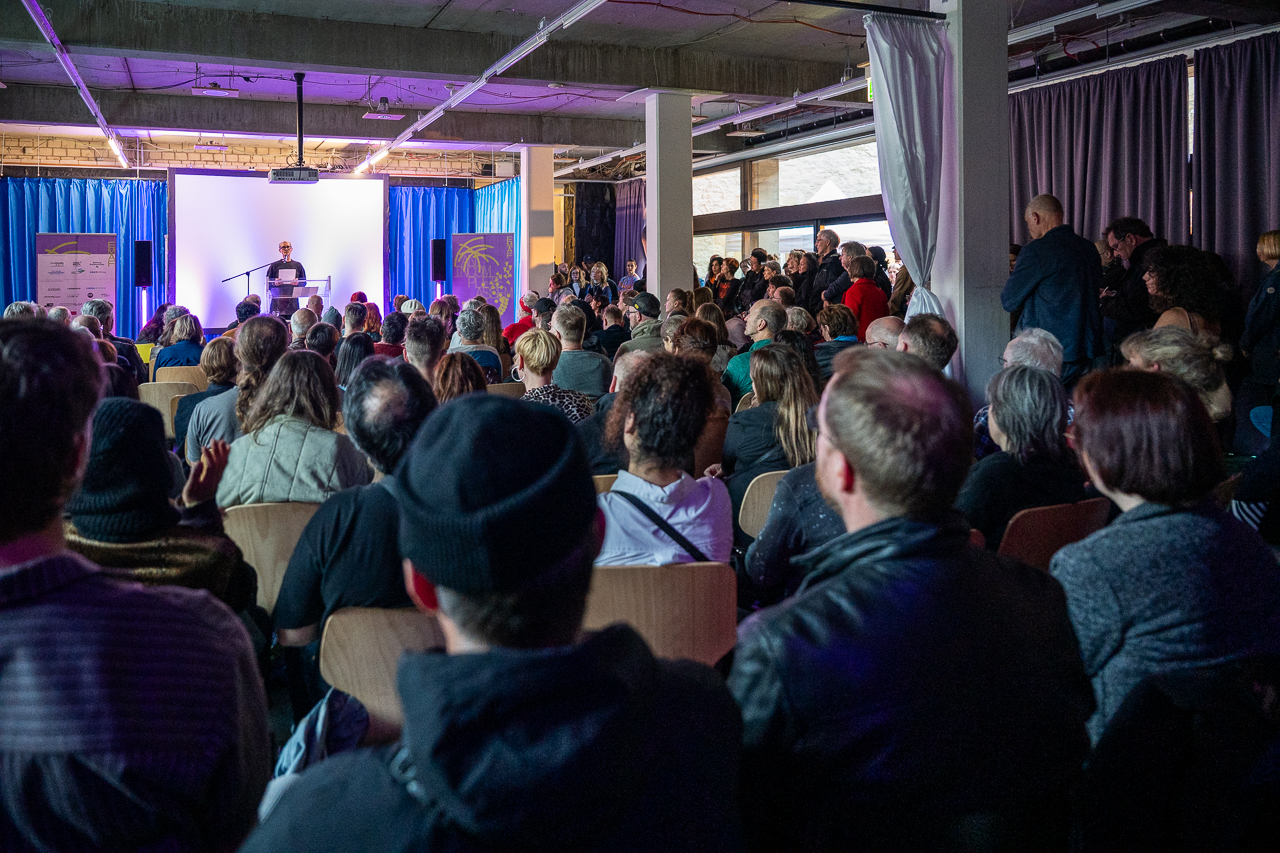
“An Incomplete Assembly” is the theme of the European Media Art Festival 2026. Yet the audience that gathered last night could hardly be called incomplete: around 1000 people attended the festival’s opening at Kunsthalle Osnabrück.
Since this morning, our venues are open to the public again. As part of the film programme THEY GAVE US FLAMES, WE MADE A FIRE, curated by Ana Vaz around the festival theme, Myriam Lefkowitz’s performance Vestibules was staged for the first time at 11:00 at Haus der Jugend. It deals with the ‘digestion’ of images. Vestibules is an invitation to a small group to lie down and close their eyes. “Once the group is lying horizontally, with their eye vision turned off, I begin a vocal score guiding the group through images and sensations”, says Myriam Lefkowitz. Gradually, a “somatic fiction” begins to unfold.
The performance will take place for the third and final time this evening at 19:00 at Haus der Jugend. Please register in advance at presse@emaf.de. Thank you very much!
Unfortunately, the performance MAKE THE SILENCE COUNT by Danielle Brathwaite-Shirley, scheduled for 15:30 today at Kunsthalle Osnabrück, has been cancelled. It will be replaced by the talk CURATING AS HACKING by Amanda Abi Khalil.
In her talk, Amanda Abi Khalil proposes a curatorial practice whose purpose is to contribute to the commons in times of collapse. Building on a decade of interventions with Temporary Art Platform (TAP), it will present art projects which are embedded directly into social reality at a 1:1 scale. Set against conditions of polycrisis including wars, genocides, forced migrations, and intertwined economic and environmental collapses, the conversation will present how curatorial practices can open fissures within social and cultural systems - today at 15:30 at Kunsthalle Osnabrück.
In our Campus section, HfG Karlsruhe will be offering another guided tour of sites of investigation in the city tomorrow at 13:00. The HfG’s COLONIAL CRIMES UNIT uses forensic and speculative methods to track down and identify human and non-human witnesses to colonial crimes within the urban space of Osnabrück – supported by specially developed technological tools. We’ll meet tomorrow at 13:00 at Lagerhalle.
Tomorrow’s discussion, entitled LAKI ŠTRAJK, featuring filmmaker Isidora Ilić and a guest, will offer insights into the student-led protest movement in Serbia, which has been successfully occupying educational institutions for over a year to protest against government corruption and mismanagement.
Since November 2024, in reaction to the collapse of the Novi Sad train station, student-led protests have spread across Serbia. Demanding accountability from the authorities for the 16 victims, the protests quickly spread from the Faculty of Dramatic Arts in Belgrade to universities and high schools across the country. Started by daily traffic blockades, the movement grew into nationwide public acts of civil disobedience, engaging citizens, workers, farmers and receiving support from cultural workers and artists. Months of persistence of the movement and mobilising force resulted in violent use of force by the state against the demonstrators during the summer.
Isidora Ilić and her guest invite you to discuss the occupation of faculties as a political strategy, the work required to keep a protest movement alive over time, and the international neglect towards the student-led protests. The discussion will be held in English and starts tomorrow at 15:30 at Kunsthalle Osnabrück.
The hugely successful Expanded Cinema series UNBURDENED RECOLLECTIONS continues this year with a new concept. Initiators Anja Dornieden and Juan David González Monroy have invited curatorial duo Mark Toscano and Zena Grey from Los Angeles to show experimental films and videos from the 1960s and 70s across two evenings. The works featured in EXPANDED CINEMA: A TRIBUTE TO GENE YOUNGBLOOD’S BOOK don’t just expand our perception but also our consciousness. Tomorrow and the day after tomorrow at 17:30 at Haus der Jugend.
Picture Copyright: Angela von Brill
04/13/2026EMAF 39 - Campus
In just over a week, the 39th European Media Art Festival will kick off in Osnabrück – this time with the theme ‘An Incomplete Assembly’.
One of the festival’s sections is the EMAF Campus. The campus involves classes and groups from art schools and universities showing current works and projects specially produced for the festival. This year, students from The Hague, Ghent, Karlsruhe, Bremen and Osnabrück are our guests at the EMAF, with their installations, sculptures, performances and guided tours taking over art spaces and public settings.
In the HFK BREMEN project headed by Any Jackson Chaturanga, a gymnasium becomes the starting point for an exploration of bodies in expectation and movement. In individual and collective choreographies, they try out what can be heard, said and experienced within the framework of set structures.
Visual and sound artists from the LUCA – SCHOOL OF ARTS, GHENT develop screenings and interventions in public space which are created in collective dialogue with the location. They unfold as a sort of a composition in real time that interrogates the politics of the everyday places they find.
The Master programme in Artistic Research at the ROYAL ACADEMY OF ART, THE HAGUE is represented with video works, installations, sculptures and performances that revolve around pattern formation and repetition, infrastructures and subversion as well as the materialism and movement of memory.
The HFG KARLSRUHE’S Colonial Crimes Unit uses forensic and speculative methods supported by a specially developed technological aid in order to track down and apprehend human and non-human witnesses of colonial crimes in Osnabrück’s urban area.
The works of the Institut für Kunst/Kunstpädagogik at the OSNABRÜCK UNIVERSITY weave together academic research, technology and artistic practice. They deal with the open process between sets of rules and imagination and ask how other codes, temporary alliances and hybrid places of learning might be created.
The MUSIC AND ART SCHOOL OSNABRÜCK is developing a spatial installation that grapples with visible and invisible institutional structures and codes.
Picture Copyright: Cemre Eraslan, Den Haag
04/02/2026EMAF 39 - Talks & Workshops
This year’s EMAF talks and workshops take a hands-on look at the everyday realities of cultural work. Aimed at filmmakers, curators, producers, organisers and students alike, the programme focuses on how we work – on the ground, in process and in relation to one another.
While we are well-versed in critiquing the counter-productivity of institutions – rightly so – this programme curated and moderated by Franziska Pierwoss asks a different question: what might productive responses to censorship, institutional cowardice and collective exhaustion look like?
With a practice-oriented approach, this programme centres methodologies that intervene directly: projects that claim public space through digital means such as Alternative Monument: Migrating Memory by the Alternative Monument collective. Rooted in queer, feminist and migrant-centred perspective, this project counters xenophobic narratives and continues to grow through collective workshops.
The immersive games and performances by Danielle Brathwaite-Shirley confront and dismantle entrenched hegemonies. Their work connects archiving as a political practice and gaming as a contemporary collective form for conversations about identity, privilege and systemic oppression that undermine expectations.
Moving beyond theory, the programme shares concrete tools of collaboration, equipping participants with confidence to intentionally practice different structural approaches in institutions, festivals and our own work.
Seeking inspiration from peers, a conversation with filmmaker Isidora Ilić and guests will offer insights into the protest movement in Serbia that has been successfully occupying educational institutions for over a year in response to government corruption and mismanagement.
And finally, to counter the crises of imagination and dominance of authoritarian narratives, Alicja Rogalska’s workshop-based artistic practice invites participants to playfully apply utopian imaginaries to lived reality.
Across this series of talks and workshops, the EMAF audience is warmly invited to rehearse forms of (self-)organising within existing frameworks while also provoking and bending them.
We look forward to welcoming you in less than three more weeks! Accreditations are still available here.
See you soon!
Picture Copyright: Alternative Monument collective
03/30/2026EMAF 39 - Programme now online
With this year’s thematic focus, An Incomplete Assembly, we aim to examine the role and responsibility of institutions - including art institutions first and foremost.
In a climate of rising attacks on artistic freedom and freedom of speech, what spaces for free expression can and must they provide? In which areas, however, do they hinder open exchange and encounter? What benefits do they offer, to whom, and at whose expense? How can their resources be utilised or redirected to bring about positive change?
These questions will be explored in the main exhibition, a specially curated programme of films and performances, and a series of talks and workshops. These considerations also play a part in festival sections such as the International Selection, the Campus and the Artist in Focus series.
You can find further information here on our website and on our social media channels. Accreditations are available here until 17 April.
We look forward to seeing you there!
03/17/2026EMAF 39 - Outlook on the Film programmes
We are very happy today to give you a first glimpse of this year’s film programmes. A total of 30 short and four feature-length films have been selected from the submissions made to the open call, with these contemporary titles entering into dialogue with three additional historical films. Located between formal experimentation and pop cultural playfulness, looking back in documentary fashion and critical analyses of the present, these works show the versatility of film as an artistic and political medium.
Many of the shorts employ subversive energy and defiant humour to take a stand against prescribed silence and political impotence. What We Said to Brussels Airlines (BE/CD 2026) by the Congolese-Belgian Collectif Faire-Part interrogates the contradictions of artistic commissions in unflinching style: what, for example, is to be done when a Belgian airline offers to show their films, which are deeply rooted in anti-colonial resistance, on their flights? The four artists allow us to participate in their thought processes about the forms of entanglement and possibilities of intervention. Alee Peoples’ Slowest Smile (US 2025) combines images and sounds, theory and song, into an unorthodox attempt to describe the downfall of an empire: from a panoramic image of capitalist exploitation to iconoclastic interventions before a Roman backdrop, from the slowest smile to a sinking ship.
Various films set collective action and the informal sharing of knowledge against the infrastructures that underpin the seeming normality of our present. A Bundle of Silences (PR 2025) by Sofia Gallisá Muriente reconstructs a 1983 bank robbery in which a Puerto Rican revolutionary group made off with several million dollars from an American bank. In an blend of personal recollection, archival footage and film material processed using coffee and tobacco, the work reflects on memory and silence. In Local Sensations (TH 2026), Tulapop Saenjaroen asks how we keep hold of the present and envision the past without recourse to the violence of a monumental order. The film weaves together graphically designed text with footage of collective processes: unstable forms made of glass, musical improvisation and wanderings through public space allow fleeting topographies to be created and counter the monumental with the momentary.
Further short films by: Basma Al-Sharif, Stephanie Barber, Magdalena Bermudez, Arief Budiman, Anouk Chambaz, Lin Htet Aung, Onyeka Igwe, Daniel Jacoby, Juliane Jaschnow & Stefanie Schroeder, José Jiménez, Taufiqurrahman Kifu& Hattie Wade, Vika Kirchenbauer, Martin Moolhuijsen, Peng Zuqiang, Adam Piron, Leonardo Pirondi, Marta Popivoda, Steve Reinke, María Rojas Arias, Viktoria Schmid, Mike Stoltz, Elisabeth Subrin, Maryam Tafakory, Yuliya Tsviatkova, Utkarsh and Saarlotta Virri.
Among the feature-length works, we come across highly personal engagements with places and their afterlives in our embodied and media memory. The starting point for Kamal Aljafari’s most recent documentary is rediscovered MiniDV footage from Gaza shot in 2001. Back then, Aljafari set out in search of a man who he had met while incarcerated in 1989. With Hasan in Gaza (PS/DE/FR/QA 2025) documents his trip from the north to the south of Gaza, accompanied by Hasan, a local travel guide: an encounter whose directness is as urgent as it is tender, with people who resist the violence of the occupation in places that have been destroyed for ever.
The animated feature Bouchra (US/IT/MA 2025) by Meriem Bennani and Orian Barki draws on an entirely different cinematic register to tell the story of a young Moroccan filmmaker working on an autobiographical film in New York. Her own life – her artistic search, her romantic attachments, her tense relationship with her mother following her coming out – increasingly merges with that of her film double. Bouchra moves elegantly between times and places, self-interrogation and dialogue, lived experience and how it is processed through narrative.
Different narrative layers also merge in Nicolás Pereda’s Everything Else Is Noise (MX/DE/CA 2026). The film portrays three contemporary composers in Mexico City and what they say about themselves and each other. The shoot for a television interview in the flat of one of the protagonists sets the scene for a chamber piece in which affection and solidarity, respect and rivalry between the three women flow together in amusingly absurdist fashion, rhythmically punctured by power cuts, a barking dog and the sound of the street.
The overtly political dimensions of playing with revealing and camouflaging one’s own person is explored in one of the historical documentaries. Underground (US 1976) by Emile de Antonio, Haskell Wexler and Mary Lampson is based on an interview with leading members of the Weather Underground, a militant group which had committed itself to the overthrow of the US government. Interspersed with archive footage of revolutionary movements worldwide, the protagonists’ testimonies – with their backs facing the camera to protect their identities – come together to form a differentiated portrait that refutes the group’s portrayal in the mass media.
Further feature-length films by: Tenzin Phuntsog, Mohamed Soueid and Chetna Vora.
Expanded Cinema: Unburdened Recollections
This year’s edition of the expanded cinema series Unburdened Recollections also looks back as it continues with a new concept. Initiators Anja Dornieden and Juan David González Monroy have invited curators Mark Toscano and Zena Grey from Los Angeles to show experimental films and videos from the 1960s and 70s over two evenings. The starting point for their programme is Gene Youngblood’s 1970 publication, in which he describes expanded cinema as an art form that doesn’t just liberate film from the restrictions of the cinema setting, but thus also expands our perception and consciousness.
Classics and rediscoveries by: Arlo Acton & Terry Riley, Scott Bartlett, Jordan Belson, Tom DeWitt Ditto, Allan Kaprow, Yayoi Kusama & Jud Yalkut, Pat O’Neill, Lillian Schwartz & Ken Knowlton, John Schofill, Single Wing Turquoise Bird, Aldo Tambellini, Stan VanDerBeek & Ken Knowlton, James Whitney, John Whitney, and Jud Yalkut & Nam June Paik.
Film and art professionals can request accreditation here.
The exhibition An Incomplete Assembly, curated by Inga Seidler, shows current works of media art from around the world largely chosen through the annual public call for entries. The collected positions that comprise the exhibition were produced in the last years and extend from installations via film works all the way to digital interventions.
The thematic starting point of the exhibition is the concept of assembly: the coming together of voices, images, bodies and temporal orders. Wherever such constellations keep reoccurring, processes become ritualised and narratives stabilised, institutional structures are formed. They organise the public realm, regulate participation, mark belonging – and produce exclusion.
Institutions don’t just appear as static constructions or clearly outlined organisations here, but rather as performative ordering principles: as a set of interlinking spatial arrangements, media framings and temporal regimes that structure perception and shape behaviour. The participating artists explore how such ordering principles are produced – through repetitions, synchronisation, narrative codification and the setting of a spatial focus – how they manifest themselves and how they are constantly reproduced each time they are carried out. At the same time, they ask where these structures become brittle and what other forms of coming together become visible in the process.
Robin Kötzle’s two-channel installation Sehen wer wir sein (s|w)ollten analyses how the media constructs political events. Excerpts from the East German TV show Aktuelle Kamera and the West German news programme Tagesschau run in parallel, reporting on protests between 1952 and 1991. When a particular event doesn’t appear in the respective other system, the screen remains black. This formally precise approach allows ideological framings, linguistic codifications and historical gaps to be experienced. What’s visible turns out to be a result of institutional decisions – something that can be created, but just as easily refused.
In Built to Order I, Bethan Hughes casts her gaze on a housing estate in Berlin’s Neukölln district and examines architecture as an object of projection for social ideas. Archival material, found footage and newly shot images unfold on two screens situated opposite from one another, with the interplay between sculptural elements, light and sound providing additional intensity. Hughes shows how surveillance, acts of discipline, projections and racialised attributions are inscribed into built structures. Architecture doesn’t function as a neutral backdrop, but rather as an active co-creator of social order.
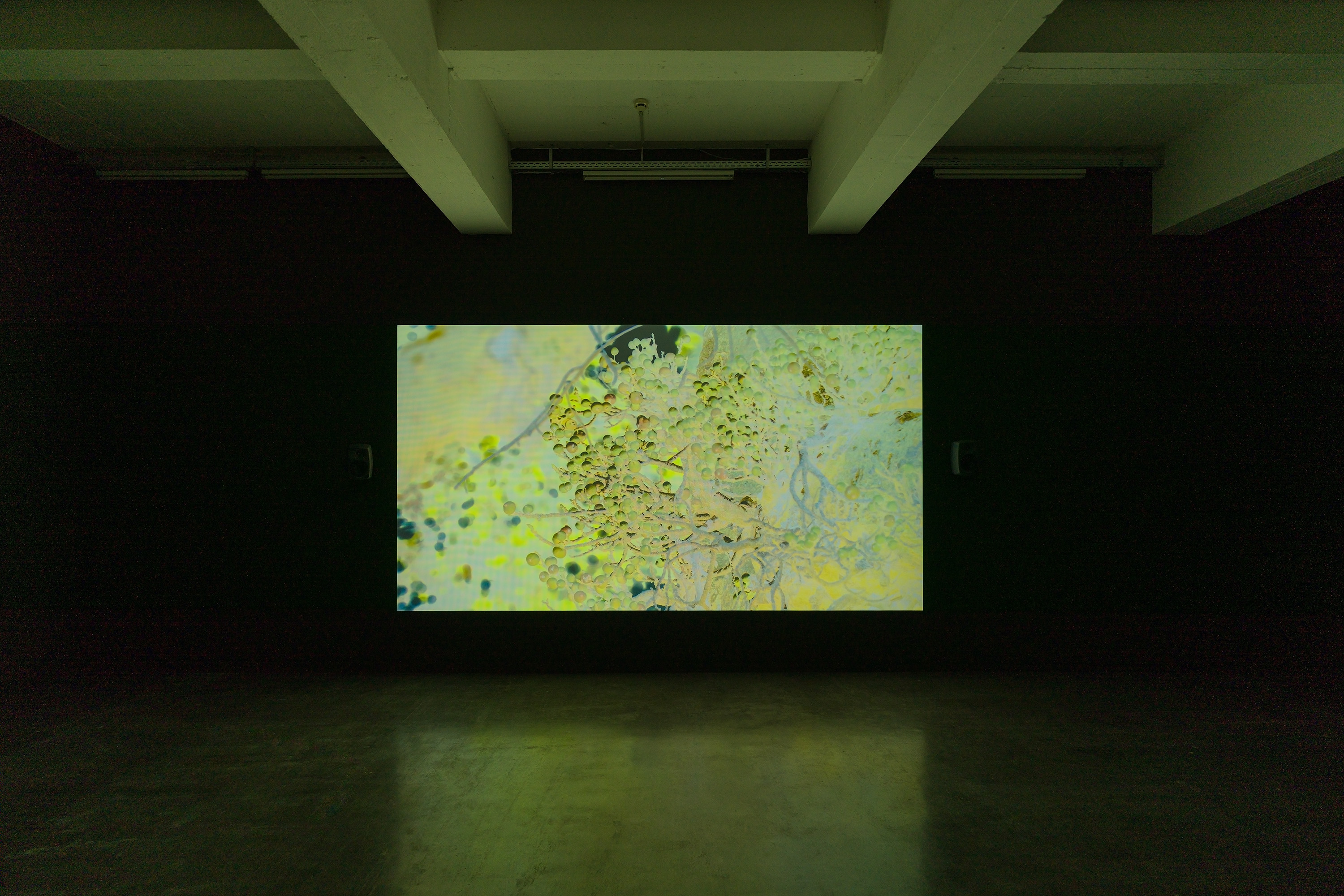
Bianca Baldi expands this perspective to include a temporal dimension. In Hear her calendar system a year of thirteen months, her starting point is a photograph of a fig tree in Ethiopia from her family archive. From this, she progressively grapples with administrative and calendar systems from the colonial eras. Video, sketches and a vocal composition become superimposed on linear and cyclical time models. The tree appears both as a more-than-human witness of historical violence and the embodiment of alternative conceptions of time. History becomes legible here not as a closed chronology but rather as a changeable structure.
Sarah Reva Mohr examines power dynamics in social and physical spaces and in relationship to humans and animals. The work sensational view, tired screams also deals with an institutionally organised space: the Barcelona zoo. In this installation, a multi-layered analysis of the zoo unfolds, a place torn between the promise of care and the exertion of power. Different perspectives reveal the regime of the colonial gaze and the aestheticisation of control. The zoo becomes an apparatus in which sight, knowledge and hierarchy intertwine and power relations within society materialise.
In Jarramplas, Yalda Afsah examines a century-old ritual in Piornal, Spain, in which one of the village’s inhabitants puts on a costume and has carrots thrown at them by the crowd. This film work focuses on the structure of assembly: on the intensity of bodies connected in space, on collective action and the dynamics created when individual gestures become synchronised within a group. By keeping essential elements of what’s happening outside the frame, Afsah shifts the focus away from a folkloristic narrative on to the mechanisms which form community.
With the Alternatives Denkmal für Deutschland, the Alternative Monument collective shifts their engagement with institutionalised memory into the public and digital realm. Their augmented reality project doesn’t possess a permanent physical form, but is activated in each individual situation via mobile devices instead. Visual collages, sculptural elements and sound fragments connect individual narratives of migration, exile and displacement. The monument isn’t erected through materiality or duration here, but rather by collective actualisation. Memory can be experienced as a polyphonic process that resists any final fixed form.
As part of the Talks programme curated by Franziska PIerwoss, a workshop put on with the Alternative Monument collective opens up an “Alternatives Denkmal für Deutschland” as a living platform for exchange and experimentation - and will explore together with the participants how a contemporary monument to migration can be developed in public space despite structural restrictions.
The works that make up An Incomplete Assembly show institutions as choreographies of images, bodies and time structures which direct behaviour and organise belonging. By revealing media blind spots, architectural inscriptions, temporal patterns and memory political emphases, they open up spaces in which order doesn’t appear as a given, but rather as something to be negotiated.
Film and art professionals can request accreditation here.
We look forward to welcoming you in April!
02/17/2026EMAF 39 - Artist in Focus: Marwa Arsanios
In its Artist in Focus series, EMAF presents the cinematic work of prominent contemporary artists, at times in dialogue with other films or contributions related to their work. This year, we are featuring a body of work by the Lebanese-born, Berlin-based artist Marwa Arsanios (born 1978). By doing so, we are honouring an internationally acclaimed artistic practice, where film, research, political imagination, and critical intervention are closely interwoven.
At the heart of the programme is the ongoing five-part film series Who Is Afraid of Ideology? (since 2017). Here, Arsanios accompanies feminist collectives and initiatives in Iraqi Kurdistan, Syria, Lebanon, and Colombia whose ongoing struggle for land communalisation and recuperation is inextricably linked to their fight for self-determination. Through an ongoing conversation, Arsanios portrays women practising collective, anti-capitalist and anti-patriarchal forms of coexistence in rural regions, defending traditional land use practices against privatisation and colonial occupation, or campaigning for the restoration of historical commons. Knowledge transfer, solidarity and support are essential to these processes and are reflected in the use of the medium of film.
The most recent, fifth part of the series, Right of Passage (2026), unfolds in the dream space where the boundaries that define property and territory, that separate the human and the non-human, past and present, are suspended. This permeability enables different “political animals” to pass freely, facilitating the articulation of traumatic losses and enabling new alliances to form.
In dialogue with her own work, Arsanios presents films by Simone Bitton, Mohammad Malas, and Reem Shilleh. These are complemented and expanded upon through workshops, readings, and talks with Ali AlAdawy, Haytham El Wardany, and Stefanie Baumann. Arsanios outlines the guiding questions as follows:
“How can we learn from films that emanate from the ground and are grounded in land struggles, that also become in and of themselves pedagogical objects? What filmic forms are constituted according to the topography of a place, its geographies and soils? And how, in its turn, does the film set become a pedagogical space for these struggles?”
As in her earlier works, Arsanios reflects on the cinematic image and her own implication in the processes of image-making, merging documentary and fictional storytelling, militant filmmaking, and artistic intervention. In Have You Ever Killed a Bear or Becoming Jamila (2014), we encounter the legendary Algerian revolutionary Djamila Bouhired in various incarnations across different media. Using Bouhired’s iconic image as a starting point, Arsanios considers how socialist projects and national liberation movements of the past have either promoted or marginalised feminist groups. In Amateurs, Stars and Extras or Labor of Love (2018), the film set becomes a place where the invisible forms of reproductive labour that lend stability and permanence to the capitalist system are brought to the fore. In complexly constructed, staged and documentary scenes, women in Mexico and Lebanon discuss work, leisure, and resistance.
Biography:
Marwa Arsanios’ practice centres around structural questions. From architectural spaces, their transformation and adaptability, to artist-run spaces and temporary conventions, her practice tends to make space within and parallel to existing art structures, allowing experimentation with different forms of assemblies. Her most recent solo shows include: Haus für Kunst Uri (2026), Joan Miro Foundation (2025), Artium Museum (2025), BAK Utrecht (2024), Heidelberger Kunstverein (2023), Mosaic Rooms, London (2022) and Contemporary Arts Center, Cincinnati (2021). She participated in numerous international group shows such as Documenta 15 (2022), the Sydney Biennial (2022), the 11th Berlin Biennale (2020) and the Gwangju Biennial (2018). Her films are regularly shown at international film festivals.
Picture Copyright: Mariam Mekawi
02/05/2026EMAF 39 - Register now!
The European Media Art Festival will begin in Osnabrück on 22 April. Film and art professionals can now get accredited online here.
Accreditation grants you free access to all film programmes, exhibitions, performances and talks and includes a free copy of the festival catalogue.
Students can register at the reduced rate of €20.
To apply for free press accreditation, please email presse@emaf.de.
The deadline for accreditations is 17 April.
We look forward to welcoming you in April!
01/28/2026EMAF 39 - Thematic Focus: An Incomplete Assembly
Institutions strive to organise volatile relations, such as power, work, privileges, language and emotions, as efficiently as possible, in order to establish a permanent order. What benefits do they offer, to whom, and at whose expense? And under what conditions are they prepared to change this order once it has been established? These questions also arise in relation to the role and responsibility of cultural institutions. Not only have massive attacks on artistic freedom called into question the legitimacy of these institutions, but they have also revealed the inequalities and exclusions within the cultural landscape. It can be assumed that the codes of conduct, mission statements, and other written commitments with which an increasing number of cultural institutions present themselves to the public articulate an external pressure to clarify their ethics and programmes, as well as an internal uncertainty within the institutions themselves. Is there a world beyond institutionalisation, or an alternative set of codes, agreements and forms of assembly? How might these play out in the context of art and cultural work?
As part of this year’s thematic focus, An Incomplete Assembly, we will use a variety of events, including talks, exhibitions, film programmes, performances, and workshops, to explore the capabilities of institutions: what statements, attitudes and actions they enable, but also what they overlook, ignore or actively prevent; how the standardisation of language, bodies, spaces, and time reinforces existing structures, and how artistic and non-artistic movements respond to these normative demands.
Curated by Inga Seidler, the exhibition views institutions as “performative ensembles,” choreographed processes, and collective entities comprising roles, rhythms, and unspoken agreements that can be interpreted, modified, interrupted and improvised. The presented works use movement, music, and communal situations to reveal these structures, rendering them physically and temporally tangible. They explore the spaces and possibilities that arise when processes come to a standstill, roles are challenged, and codes are interrupted or changed. In doing so, they demonstrate how institutional systems standardise behaviour and organise affiliations, yet remain malleable and susceptible to disruption.
The film programme on this theme, curated by Ana Vaz, thinks beyond the confinement of the cinematic to its reception in the form of finalised works. It is devoted to investigating practices that assume and question processes of making not as a means to an end, but rather as constitutive to the works. It is a series that aims to look beyond representation into the very conditions of the apparition of moving images — be they cinematic or performative. It considers the agency of its makers, participants and users, establishing connections between on and offscreen, the stage and the backstage. Here, cinema becomes rather a mode of attention, of attunement, and of collective making, a means for the rehearsal of desirable and furious futures.
This year’s talks and workshops, curated by Franziska Pierwoss, take a hands-on look at the everyday realities of cultural work. Aimed at filmmakers, curators, organisers, and students alike, the programme focuses on how we work – on the ground, in process, and in relation to one another. While we are well-versed in critiquing the counter productivity of institutions – rightly so – this programme asks a different question: what might productive responses look like? To censorship, institutional cowardice and collective fatigue? Highlighting practices that intervene directly – such as digitally claiming public space and confronting entrenched hegemonies – the programme invites audiences to organise within existing frameworks while also bending them.
In their series “What Is Needed,” Raquel Schefer and Philip Widmann explore the “Mostra Internacional de Cinema de Intervenção,” a festival that took place in post-revolutionary Portugal in 1976. It was a unique effort to connect movements of liberation and emancipation. The festival’s combination of militant films from the Global North and South suggests that cinema’s potential for intervention was essentially indebted to Third-Worldist networks of audiovisual independence. Through the lens of the five decades that have passed since the Mostra, “What Is Needed” looks at the contradictions of integrating “intervention” into the institutions of a post-fascist, liberal democratic society that, contrary to all claims, sustains Western supremacy. The series is a collaboration with Doc’s Kingdom and the Paranational Cinema – Legacies & Practices project at the University of Zurich.
About the curators:
Franziska Pierwoss is an artist working with performance and installation. Her projects explore food systems as political symbols and materials within social and financial spheres. She studied in Leipzig and Beirut and has shown work at Sharjah Biennial, nGbK, Jameel Arts Centre and Urbane Künste Ruhr.
Raquel Schefer is a filmmaker, a film programmer, and an Associate Professor at Sorbonne Nouvelle University. She is a co-editor-in-chief of La Furia Umana journal, and a former programme advisor for the IDFA and Encuentros del otro cine (EDOC) festivals.
Inga Seidler is an independent curator and project manager based in Berlin. She was exhibition curator for the transmediale festival and head of the web residency programme at the Akademie Schloss Solitude. Since 2021, she has been curating the exhibitions at EMAF.
Ana Vaz is an artist and filmmaker. Her film-poems interrogate cinema as an art of the (in)visible and instrument capable of transforming human perception. They highlight the profound contradictions of our time and question, above all, the destructive practices of colonial modernity.
Philip Widmann is a researcher, programmer and filmmaker, currently working in the project Paranational Cinema—Legacies & Practices at the University of Zurich. He edited Film Undone—Elements of a Latent Cinema, a collection of approaches to unmade and unfinished films.
We look forward to your visit!
12/23/2025EMAF 39 - Thank you!
Yesterday marked the end of our call for entries, and we are thrilled about the large number of works we have received over the past few months—thank you so much for your trust!
Our programming teams are already busy reviewing your entries to develop next year’s exciting festival programme. We look forward to keeping you posted about the preparations for the 39th EMAF in the coming months!
See you soon!
10/20/2025EMAF 39 - Meet the Programmers
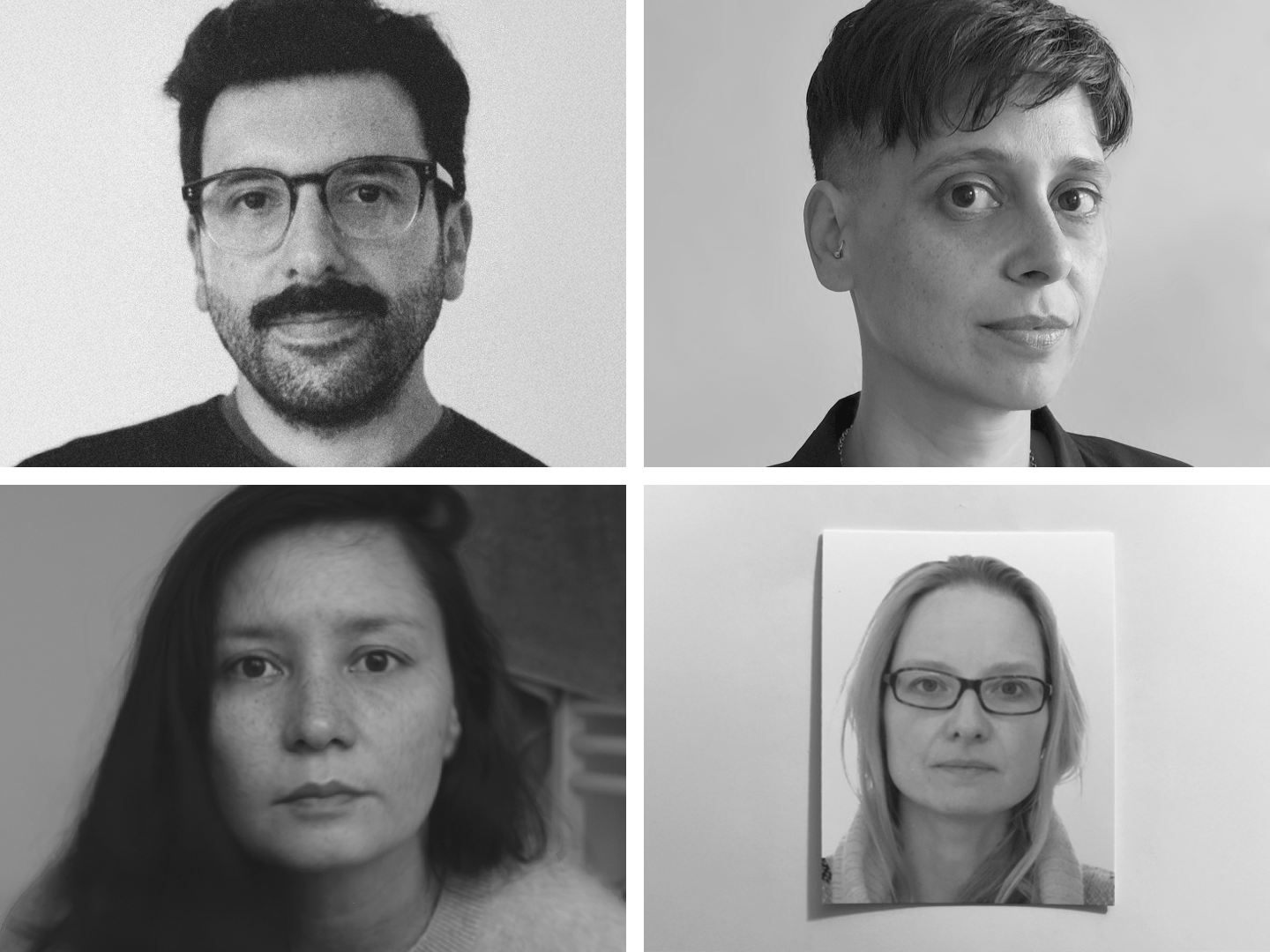
Viewings have begun, and we are delighted to introduce the selection committee, who will be discussing the many film entries received to compile the festival programme over the coming months. Juan David González Monroy, Rita Macedo, Christina Stuhlberger, and Clarissa Thieme were responsible for programming the short and feature films last year, alongside Katrin Mundt. New to the team this year is Tendai Mutambu, whom we warmly welcome!
We are looking forward to working together in the coming months! The results of the selection process will be announced in mid-March.
Programming Team 2026
Juan David González Monroy is a visual artist based in Berlin. Since 2010, he has collaborated with Anja Dornieden under the moniker OJOBOCA. Their practice focuses on photochemical film and cinema as a social ritual. OJOBOCA’s films, installations, and performances have been featured at festivals, solo screenings, and exhibitions, including the Museum of the Moving Image, ICA London, Berlinale, and New York Film Festival. Juan works as an archivist at Arsenal – Institute for Film and Video Art, where he programmes the series Condition Report, focused on screening film prints from the archive.
Rita Macedo is a filmmaker and artist based in Berlin. Her work, shown internationally in exhibitions and film festivals, moves between non-fiction, speculative invention, and narrative disruption to probe the unstable terrains of meaning and memory. Through a practice that resists fixed interpretation, she investigates shifting relations between image, perception, and time. She is an Artistic Associate at the Braunschweig University of Art.
Tendai Mutambu is a writer and curator whose work centres on contemporary artists’ moving image and the essay film, with a focus on Black diasporic practices. Recently, he was Development Editing Fellow for Logic(s) at Columbia University’s INCITE Institute, and an associate producer for Aura Satz’s Preemptive Listening. He has held programming roles at Spike Island, LUX Moving Image, London Film Festival, Berwick Film and Media Arts Festival (all UK), and Govett-Brewster/Len Lye Centre (NZ). He’s a regular contributor to Ocula, Art Monthly UK, and ArtReview.
Christina Stuhlberger is an artist and filmmaker based in Vienna and Brussels. She co-founded elephy, a collective and platform for film and audiovisual art, and serves as a guest programmer for the Courtisane Film Festival in Ghent. In addition to her artistic work, she is a doctoral researcher in the arts at the LUCA School of Arts in Brussels and teaches in the Doc Nomads international master’s program in documentary filmmaking.
Clarissa Thieme is a filmmaker and artist. Her films, installations, and performative interventions focus on the fissures between individual memory and its translation into processes of historical objectification. Her latest work explores a living archive as a new commons and vulnerability as an artistic strategy of resistance and solidarity. Thieme co-founded ARchipelago, a site-specific archiving platform, and the open-archive initiative Između Nas/Between Us at the Sarajevo Video Archive. She is a PhD candidate at the Artistic Research Center (ARC) at the Vienna Film Academy (mdw).
The 39th European Media Art Festival will take place from 22 to 26 April 2026. The exhibition at Kunsthalle Osnabrück will continue beyond the festival, closing on 25 May 2026.
We are looking forward to your entries - this year´s deadline is 22 December 2025.
09/16/2025EMAF 39 - Call for Entries
Media artists from around the world can now enter their work to be considered for the 2026 European Media Art Festival. The online platform is already open - please click here.
This year’s deadline for entries is 22 December 2025.
We welcome current works in the categories Film (experimental short and feature films), Installation (installative, interactive, spatial or sculptural media art works), and Expanded (performances, live events, or workshops).
Entering works is free of charge.
Our international curatorial team will compile the programme for the upcoming festival from the entries received. Fees will be paid to all artists whose work is selected for the festival. Premiere status is not necessary. Please refer to our regulations for more details on the entry and selection process, as well as technical requirements.
The 39th European Media Art Festival will take place from 22 to 26 April 2026. The exhibition at Kunsthalle Osnabrück will continue beyond the festival, closing on 25 May 2026.
We are looking forward to your entries!
05/12/2025International Museum Day - Guided Tour with Curator Inga Seidler
On International Museum Day on May 18, exhibition curator Inga Seidler will give a guided tour of this year’s EMAF exhibition Witnessing Witnessing at 3 p.m. at the Kunsthalle Osnabrück. The exhibition features works by Agil Abdullayev, Alisa Berger, Karolina Breguła, Doplgenger (Isidora Ilić and Boško Prostran), Hannah Hallermann, Flo Kasearu, Gabriela Löffel, and Benedikt Terwiel. Admission is free.
You will also have the opportunity to watch Dimitris Athiridis’ documentary film exergue – on documenta 14 (GR 2024, 848 mins, German, English, Greek with English subtitles). The last four chapters of this 14-hour film will be shown from 1 p.m. to 6 p.m.
exergue – on documenta 14 follows artistic director Adam Szymczyk and his curatorial team as they work on the world’s most important art exhibition, which first took place in Kassel and Athens in 2017. The result is a unique look behind the scenes of the institutional art world in a changing political landscape. Parts 1 to 4 can be seen on May 16 from 1 p.m. to 6 p.m., and parts 5 to 10 on May 17 from 11:30 a.m. to 6 p.m.
04/28/2025EMAF 38 - Thank you!
After five days, the 38th European Media Art Festival came to an end yesterday. More than 160 films, installations, performances, and talks were shown and experienced at nine different locations across the city. One of the highlights was the presentation of the EMAF Media Art Prize by the German Film Critics Association (VdFk) at the Kunsthalle Osnabrück yesterday morning.
Daphné Hérétakis was awarded for her work What We Ask of a Statue Is That It Doesn’t Move (GR, FR 2024, 31’).
The film deals with the current political situation in Greece: in Athens, nothing seems to be happening, and the people are as silent as statues. But elsewhere in the city, a caryatid escapes from the museum and a splinter group calls for the destruction of all antiquities. Perhaps filmmaking is the only way to avoid turning to stone, says the synopsis.
The jury, consisting of Günter Minas, Bianca Jasmina Rauch and Hannes Wesselkämper, stated: “With anarchic humour while oscillating between documentary and fiction, the director follows a (fictitious) citizens’ initiative that wants to subvert the past by blowing up the Parthenon in Athens and replacing it with statues of people from the present day. The stagnation caused by the current political situation is transformed into a new movement, centuries-old traditions are thrown overboard with a sense of mischievous joy. Thus, What we ask of a statue is that it doesn’t move cleverly poses the question in the cinematic space: What traces of us will archaeologists of the future find?”
The jury gave a special mention to Tila•pia by Crispin Yanisi, a film “which enters into an aesthetic dialogue with the fish of its title. It explores the theme of interculturality through balanced imagery and a well-founded artistic approach, following the fate of the fish from the net to the plate”, the jury stated.
Both films were previously shown in the International Selection. This year, for the first time, all 31 films screened will receive the EMAF Award. The prize money will be divided equally among the selected artists. The winners are:
Lawrence Abu Hamdan, Ben Balcom, George Clark, Theo Cuthand, Chloë Delanghe & Mattijs Driesen, Sam Drake, Eitan Efrat & Sirah Foighel Brutmann, Zachary Epcar, Kevin Jerome Everson, Laurence Favre, Maïder Fortuné, Daphné Hérétakis, Mina Heydari-Waite, Hyejin Jung, Ferney Iyokina Gittoma, Pranami Koch, Mónica Martins Nunes, Ella McConnell, Monica Panzarino, Franca Pape, Kanthy Peng, Martyna Ratnik, Jazmin Rojas Forero, Sylvia Schedelbauer, Silke Schönfeld, Lina Selander, Jonathan Seungjoon Lee, Micah Weber, Helena Wittmann, Crispin Yanisi and Else/Xun Zhang
On the opening night alone, the Kunsthalle Osnabrück welcomed nearly 1000 visitors. We were delighted to receive so many visitors who attended the EMAF for the first time, as well as those who have been our guests for decades – thanks a lot! A huge Thank you goes also to all our supporters, as well as cooperation and media partners (which can be found here), and of course to all helping hands!
The exhibition “Witnessing Witnessing,” curated by Inga Seidler, can be visited at the Kunsthalle Osnabrück until 25 May during the museum’s regular opening hours. Guided tours take place every Sunday at 4 pm and can also be booked at presse@emaf.de.
Thank you for your interest and we look forward to seeing you next year! The 39th European Media Art Festival will take place from 22 to 26 April 2026.
Best wishes from the EMAF 2025 team!
Picture Copyright: Angela von Brill
04/25/2025EMAF 38 - Tips for the weekend
The International Selection presents works by established and emerging artists from around the world – many of them being shown in Germany for the first time. A recurring motif is the revisiting of personal and political stories in direct dialogue, but also in the encounter with places and landscapes. Some artists play with cinematic genres, especially elements of horror and suspense, which might also reflect their discomfort with the present. The more or less tamed nature – the garden, the park, the jungle – repeatedly appears as a historical backdrop, a personal anchor point or a utopian blueprint for an alternative way of living together. The following films will be screened tomorrow at 11 am at the Lagerhalle as part of the programme “A Deflected Signal”:
Dreams Of My Father, Jonathan Seungjoon Lee, KR, AR, NL 2024, 15’
Colorful Colorado Nails, Monica Panzarino, US 2024, 6’
Dreams of Sunlight Through Trees, Theo Cuthand, CA 2024, 15’
she’s waiting for the sunset, Martyna Ratnik, LT 2024, 8’
母の手紙 / Mother’s Letter, Sylvia Schedelbauer, DE 2025, 24’
The screening will be followed by a Q&A with the filmmakers (in English).
At EMAF in April 2024, Nahed Samour and Pary El-Qalqili took account of the repression and silencing of voices in Germany expressing solidarity with Palestine. One year later, Samour looks at where we are now: What to call the current societal condition? Has it already become permanent?
Together with Anita Di Bianco and Natascha Sadr Haghighian, Nahed Samour will discuss these questions in the TalkI could swear my face was touching stone: Continuities tomorrow at 1pm at Kunsthalle Osnabrück.
In her ongoing project Corrections and Clarifications Anita Di Bianco compiles daily retractions, re-wordings, distinctions and apologies to print news since September 1, 2001. Moving chronologically backwards from the present, Di Bianco suggests that the notion of historical ruptures is itself part of the misrepresentation and distortion and that the persistence of such revisions reveal a series of precedents. Natascha Sadr Haghighian’s essay What I Do Not Yet Recognize, Now at This Very Moment examines willful ignorance as part of structural racism and violence in Germany. How to unlearn the settings that shape and obfuscate one’s own perceptions – to allow for resonances with the knowledge and experience of migrant communities? In a collective reading, voices intervene in the silences and gaps. They offer testimony to continuities of denial, initiating a conversation on the challenges of speaking (up), and acts of refusal in a social landscape of anticipatory obedience.
From the feature film section, we recommend tomorrow’s German premiere of Candela Sotos’ Yrupẽ (ES 2025, 79’) – in Spanish with English subtitles.
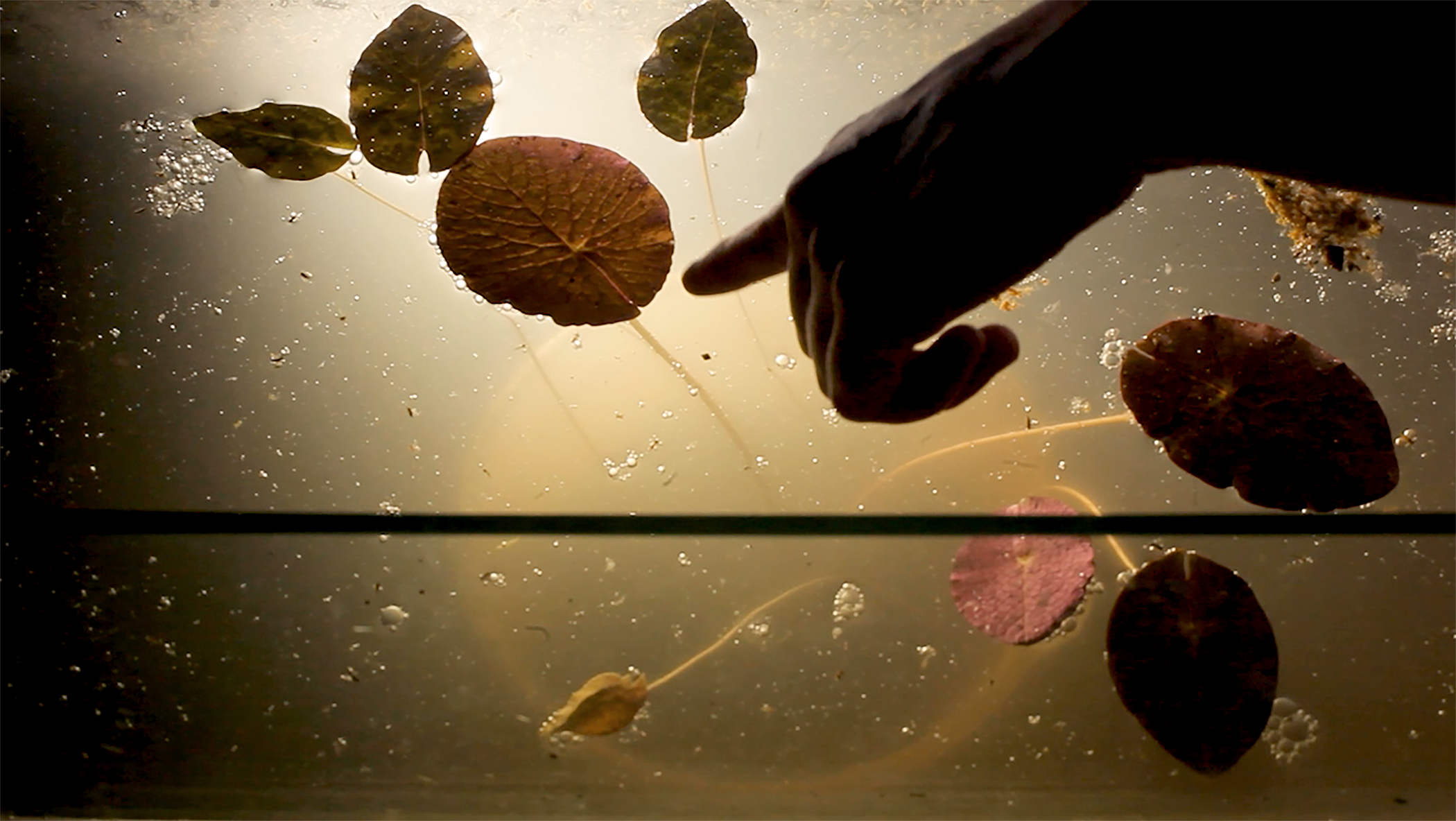
The search for ”The Irupé Flower,” a lost film by Guillermo Fernández-Zúñiga – a Spanish pioneer of scientific cinema exiled to Argentina after the Spanish Civil War – triggers a journey through family histories and national archives. As we follow the slow growth of the irupé in an aquarium in the car park of an art college in Buenos Aires, layers of images and empty spaces gradually emerge.
The screening will be followed by a Q&A session with the filmmaker (in English). The event starts tomorrow at 5 pm at the Hasetor cinema.
Although 31 films have already been honoured as EMAF award winners in the International Selection – we will be celebrating the award ceremony of the Association of German Film Critics on Sunday at 11 am at the Kunsthalle Osnabrück.
The jury members of the German Film Critics’ Association, Günter Minas, Bianca Jasmina Rauch and Hannes Wesselkämper, will discuss the films of the International Selection and then award the EMAF Media Art Prize of the German Film Critics’ Association.
After the screening of the award-winning film, all attendees are invited to join us for drinks and snacks.
If you wish, you can stay on at Kunsthalle Osnabrück afterwards and take a guided tour of the exhibition with our mediators. On Sunday at 4 pm is the last chance during the festival. There are public tours tomorrow at 12 noon, 4 pm and 6 pm, but even after the festival there will be a public tour every Sunday at 4 pm until the exhibition closes on 25 May. Groups can book a tour by emailing presse@emaf.de. Special offers and conditions are available for school groups.
Another highlight towards the end of the festival will be the feature filmMacumba (BRD 1982, 88 min.) by Elfi Mikesch on Sunday at 6 pm at the Lagerhalle. The film tells the story of Magda, who lives with her friends in a Berlin house whose days are numbered. Everyone follows their own obsessions in their own way. A certain delirium turns everyday life into a dream, into a trance-like movement towards an uncertain future. Max Taurus, a gifted sleuth who calls himself a “detective,” follows a trail that leads him to this very demolition site, where he believes he can prevent a murder. In the process, he becomes entangled in a labyrinthine story from which he cannot free himself. The crash of the wrecking ball, accompanied by the music of Silvestre Revueltas, becomes a swan song for a way of life that has its roots in the 1960s.
The screening will be followed by a Q&A with the filmmaker (in German).
The complete festival programme can be found here.
We wish you a sunny weekend at the EMAF in Osnabrück and look forward to a great second half of the festival!
04/24/2025EMAF 38 - Opening
Wow! We were delighted to welcome so many visitors to the opening of the 38th European Media Art Festival at Kunsthalle Osnabrück last night. It was a wonderful evening, and we would like to thank you for your interest and the many kind words. While spring begins with the EMAF flags for Juliane Schickedanz (director of the Kunsthalle Osnabrück), the EMAF flair swept from the shop at Bierstaße 13 to the town hall for Mayor Katharina Pötter. “The EMAF is not a classic film festival with feature-length or short films,” said outgoing State Secretary Dr. Jörg Mielke. “Rather, the EMAF is a film festival where we have a very, very strong transition from cinematic expression to an artistic form of expression with installations and productions that we don’t usually find elsewhere.”
Over four days, more than 160 films, installations, performances and talks will be presented – at various locations around the city. How about checking out the programmes of our guests from the classes of the art academies in Szczecin and Helsinki? Both can be viewed today at 1pm and 7pm respectively.
The everyday lives of six filmmakers, students at the Academy of Art in Szczecin, unfold against a backdrop of growing unrest, social tensions, dramatic political crises and wars, with an awareness of an irreversible climate catastrophe and the increasing prevalence of mental health issues. Every day there is something new in the news – both from their own country and from the rest of the world – which often has a direct impact on the lives of these young people. The short film It Will Be a Very Difficult Conversation tells the personal stories of the six filmmakers in six chapters, addressing issues that are sometimes difficult, often unpleasant, but at the same time extremely important. At 1pm at the Lagerhalle.
The work Ensemble by students from the Academy of Fine Arts in Helsinki combines film with live performance and a letter from the past: “When you think of spaces and images, you may have certain expectations: How will the image fit into the space? How will I fit into it? Our space will be in motion in terms of time and place,” it says. And further: “We don’t want you to know where the next act begins. Is there a linear progression or just a collection of beginnings and endings? Does the space have an end, or does something new begin? Sometimes the portals will open for everyone, and sometimes there are experiences that are only meant for one person. We will accompany you through projections or voices appearing around you.” Tonight at 7pm, at Haus der Jugend.
In the International Selection, you can see An Ear-Splitting Blur tonight at 10.30pm at the Lagerhalle – featuring films by Sam Drake and Lawrence Abu Hamdan.
Fragmented records in Sam Drake’s Suspicions About the Hidden Realities of Air (US 2025) reveal a hidden history of Cold War radiation experiments on humans, coming to light through a haze of manipulation and embedded studies. Desert dust sticks to the teeth and leaves its mark. Contaminated images evoke the invisible.
The Diary of a Sky (LB 2024) by Lawrence Abu Hamdan unfolds an atmospheric symphony of violence over Beirut, in which the incessant movement of Israeli military aircraft and the hum of generators during power cuts merge in a haunting way. This 45-minute video essay immerses the viewer into a frightening chronicle of everyday life, in which the skies are turned into a weapon and, through the terror of repeated attacks, into a disturbingly mundane backdrop.
New Red Order – our Artists in Focus – present their third programme tomorrow at 1pm at the Lagerhalle. A I O U (US 2019) tells of a distant future. Of a cosmic institution of unknown origin. In this place, the debt for the extinction of a life is finally paid: by resurrection.
Nosferasta: First Bite (US, PR, GB 2021) spans five centuries of colonial destruction and tells the story of Oba, a Rastafarian vampire, and Christopher Columbus, whose bite originally turned him into a vampire. Together they spread the colonial epidemic throughout the “New World.” Formally, Nosferasta is a vampire film and a series of installations. Impressionistic in style, they explore the guilt that comes from being involved in colonial conquests, acknowledging the difficulty of shaking off the legacy of centuries of vampire indoctrination. At its core is the question: How can you decolonise what is in your blood?
Give it Back: Crimes Against Realty (US 2024) is about a tour of a supposedly restituted apartment. Led by Jim Fletcher, a reformed Native American impersonator and frequent collaborator with New Red Order, it showcases real people involved in the voluntary return of land to indigenous peoples, organisations and tribes. The film is part of New Red Order’s ongoing research into the return of land by settlers to indigenous peoples, a practice that has become increasingly common over the past decade.
As part of SPECTRAL, the LaborBerlin collective will once again present the diversity of analogue film practice. A central work in this year’s presentation is the re-screening of a multi-projection performance developed by Takahiko Iimura, a pioneer of Expanded Cinema in Japan, together with composer Alvin Lucier. Thanks to LaborBerlin’s collaboration with researchers from Collaborative Cataloging Japan, the performance will be shown live and in analogue for the first time since the 1960s. Tomorrow at 7 pm, at Haus der Jugend.
The complete festival programme can be found here.
We look forward to your visit!
Picture Copyright: Kerstin Hehmann
04/14/2025EMAF 38 - Campus
In the festival section Campus, classes and subject groups from art schools and universities present their current work. Students from Helsinki, Szczecin, Braunschweig and Osnabrück are our guests at this year’s EMAF and will be showing the fruits of their labour in exhibitions, film programmes and performances at the festival cinemas and selected venues in the centre of Osnabrück.
The HBK Braunschweig exhibition presents works by students of fine art and art pedagogy. Films, videos, sculptures, performances and installations examine the connection between individual experiences and social and political contexts, focussing on different perspectives on questions of witnessing.
It Will Be a Very Difficult Conversation is a short film by students from the Academy of Art in Szczecin which seeks to express what we lack words for in everyday life: how do we engage with conflicts in our immediate surroundings? How can I produce critical art that perhaps leads to restrictions for those closest to me? How do I manage when a war splits the community that I come from?
In their film and performance event Ensemble, students of the Academy of Fine Arts Helsinki explore fundamental questions relating to the shared experience of images and spaces. For a limited period, doors open that lead us to a home, to the sea or to the surface of skin. Voices, soundscapes and the light of the projectors lead the audience into the space and the time of their imagination.
The Institute for Art/Art Pedagogy at the Osnabrück University is participating with works created in collaboration with different artists. They seek to make us aware of human boundaries in information processing and the psychological and social effects of false information and information saturation.
Students from the media laboratory at the Osnabrück University of Applied Sciences are presenting projects that draw on virtual reality, AI or physical computing to engage with the strategies of political manipulation, the modelling and tactile exploration of landscape and new forms of playful interaction.
At the Department for Everyday Records established by the Music and Art School Osnabrück, the citizen’s personal records are systematically administered and ordered by staff. Personal everyday records such as notes, receipts or contact lens packets can be handed in by citizens at the relevant office.
Until April 18 film and art professionals can register to visit the festival here.
The complete festival programme can be found here.
We look forward to your visit!
Picture Copyright: Tom Brück
04/03/2025EMAF 38 - Talks: I could swear my face was touching stone
When witnesses of violence and injustice go unheard, where are the things that happened registered, where are they stored? How can testimonies write stories that have not yet been written and break the power of a systematic lack of knowledge that secures privileges within society? These are the questions that the Talks at this year’s European Media Art Festival will be addressing. Today we would like to introduce you to the programme.
Bearing witness is itself caught up in epistemic violence: I only see what I know, recognise, have learnt to recognise. Taking the National Socialist Underground complex as its starting point, Natascha Sadr Haghighian’s What I Do Not Yet Recognize, Now at This Very Moment (2023) describes collective ignorance as the basis of structural racism and contrasts this with the self-assertion of migrant-situated experience and memory. The title of this year’s Talks I could swear my face was touching stone picks up on the affective aspects of testimony. It is taken from the poetry collection Land to Light On (1997) by Canadian writer Dionne Brand. Brand’s poetry has repeatedly engaged with the question of bearing witness, with the gap between what is inflicted and what of that is reported.
Before this backdrop, the four events are dedicated to the transhistorical dimensions of witnessing as well as corporeal and sensorial forms of knowledge, with those taking part linking together short presentations, conversations, readings and films.
The Talks are curated and moderated by Natascha Sadr Haghighian, Marc Siegel, Philip Widmann and Florian Wüst.
Technologies
Film scholars Anaïs Farine (Beirut) and Irit Neidhardt (Berlin) look at the shifting contexts of images and sounds from and about Palestine. They examine how solidarity with the Palestinian cause institutionalised through cinema has largely disappeared in present-day Germany, and identify current artistic and curatorial interventions in a field where technologies of making visible easily tend to have obverse effects. The conversation is accompanied by a wide range of audiovisual materials – from films made by West German film crews, commissioned by the PLO, to recent experimental films utilising found footage from colonised Palestine in the early 20th century, and the 2024 short film compilation made in Gaza, From Ground Zero.
Magic
Listening to the voices of the oppressed often requires us to enter unmastered territory characterised by defiant magical happenings and unexpected fantastical imaginaries. Author and philologist Sanabel Abdel Rahman (Tunis) and artist and researcher Ashkan Sepahvand (London) speak of witnesses who disrupt colonial reality through magic and storytelling. Abdel Rahman, who will join online from Tunis, shares aspects of her research on magical realism and haunting as part of Palestinian resistance, while Sepahvand focuses on figures of alterity emerging in modern Iran under geopolitical ruination.
Continuities
At EMAF in April 2024, legal and islamic studies scholar Nahed Samour and artist Pary El-Qalqili took account of the repression and silencing of voices in Germany expressing solidarity with Palestine. One year later, Nahed Samour (Berlin) looks at where we are now: What to call the current societal condition? Has it already become permanent? In another chronicling, Frankfurt-based artist Anita Di Bianco’s ongoing project Corrections and Clarifications compiles daily retractions, re-wordings, distinctions and apologies to print news since September 1, 2001. Moving chronologically backwards from the present, Di Bianco suggests that the notion of historical ruptures is itself part of the misrepresentation and distortion.
Bodies
Author and curator José B. Segebre (Berlin) will reflect on the aesthetics of waiting in queer, feminist, Black and decolonial artistic practice. He will foreground waiting as a central dimension of sumud (steadfastness), a practice of resistance that defines Palestinian daily life, both inside and outside historic Palestine. Ashkan Sepahvand will address performances and rituals of death in the context of the AIDS pandemic, which arose in the 1980s and continues in the present, focusing both on the historical transmission of knowledge between queer dancers and choreographers and on the theater of director Reza Abdoh, whose work cites the Iranian-Islamic performance tradition of ta’ziyeh.
Until April 18 film and art professionals can register to visit the festival here.
We look forward to your visit!
Picture Copyright: Anaïs Farine und Irit Neidhardt
04/01/2025EMAF 38 - Programme now online
We are happy to present our programme to you now!
It includes the themed film programmes, the International Selection, the Feature Film section, the Artist in Focus and EMAF Extended programmes, as well as exhibitions, many live performances, lectures, live music sets, and parties with guests from all over the world.
You can find all the information now at www.emaf.de and in the coming weeks here and on our social media channels!
We look forward to seeing you at EMAF 2025!
Accreditations are still possible here until April 18th.
03/20/2025EMAF 38 - Outlook on the Film programmes
This year, 31 short films will be screened in the International Selection. The programme will present works by renowned and young artists from all over the world – many of them for the first time in Germany. In the Feature Film section, nine contemporary and historical feature films enter into a dialogue. In many of these works, we encounter gestures of protest and resistance against persistent injustice and social inequality. Some artists play with cinematic genres, especially with elements of horror and suspense, which might be a response to their unease with the present. Another central motif is the revisiting of personal and political histories in direct dialogue, but also in encounters with places and landscapes. More or less tamed nature – the garden, the park, the jungle – recurs as a historical backdrop, a personal anchor point, or a utopian blueprint for a different way of living together.
In the following, we would like to give you a few first impressions of the programme.
International Selection
Variations on How to Farm a City (2024) by Mónica Martins Nunes (in artistic collaboration with Deniz Şimşek) follows the work of gardeners who, on wastelands and hills, between traffic arteries and perpetual construction sites, counter the city’s encroachment with a different form of time and coexistence: planting, harvesting, eating, and talking as daily renewed gestures that confirm their intention to stay. The urban environment in which Zachary Epcar’sSinking Feeling (2024) unfolds are the abstract lines and reflective distortions of US office architecture, populated by the bodies and voices of three people. Their memories of an incident in a tunnel triggers daydreams and fantasies of losing control, of exhaustion, and connection.
A constant buzzing in her right ear prompts Jung Hyejin to cinematically explore the fine line that separates sound from noise. In Noise: Unwanted Sound (2024), she combines medical examination and social reflection, soundscapes, and personal-poetic self-exploration to illustrate how the voices of marginalised people are stigmatised and silenced as noise. Sylvia Schedelbauer’sMother’s Letter (2025) is the filmmaker’s attempt to approximate her mother’s perspective. In the form of a letter, the mother addresses her daughter, who replies and comments with images from the family archive. The back-and-forth of the classic letter format becomes an intimate side-by-side that hints at conflict and closeness, while leaving room for questions that remain unanswered.
The complete list of films in the International Selection can be found here.
All 31 films are equal winners of the EMAF Award. The prize money, which was previously awarded to individual works, will now be shared by all selected films. A jury of the Association of German Film Critics (VDFK) will continue to award the VDFK Media Art Award at the EMAF.
Feature films
In Candela Sotos’Yrupẽ (2025), the search for a lost science film by Guillermo Fernández-Zúñiga is intertwined with delving into family history and national archives. As we follow the slow growth of an yrupẽ plant in an aquarium, images and voices emerge, revealing a history of silence, concealment, and censorship. In the summer of 1982, the Israeli army invaded Beirut and looted the archive of the Palestine Research Centre. In addition to countless historical documents on Palestine, it had contained a collection of still and moving images which the Israeli Ministry of Defence appropriated. In A Fidai Film (2024), Kamal Aljafari reclaims these images and weaves them into a counter-narrative that reconstructs a Palestinian history that has been suppressed for decades.
The Soldier’s Lagoon (2024) by Pablo Álvarez Mesa follows the trail of Simon Bolívar’s fight for the liberation of Colombia in 1819. The journey takes us high into the misty region of the Páramo, a landscape in which centuries of violence and trauma are embedded. Careful observation and conversations with botanists, historians, and artisans create a multi-layered reflection on oral history and its relation to the land. The Lie, created in 1987, is a powerful testimony to the systematic extermination of German Sinti by the Nazis. Katrin Seybold and Melanie Spitta, herself the daughter of a survivor, use previously unpublished police files, photographs and documents from racial researchers, and the memories of the few survivors of the camps to reconstruct not only the genocide itself but also the attitude of a society that ignores the right for compensation.
The complete list of selected feature-length films can be found here.
EMAF Extended
After the festival, Dimitris Athiridis’ documentary exergue - on documenta 14 (2024) will be screened alongside the EMAF exhibition at Kunsthalle Osnabrück. The film accompanies the artistic director of documenta 14, Adam Szymczyk, and his curatorial team as they plan and realise one of the world’s most important exhibitions of contemporary art, which for the first time took place in Kassel and Athens in 2017. This decision, which was part of the curatorial concept of documenta 14, sparked controversy in advance and ended with a budget deficit and a media scandal. In 14 chapters, exergue offers a unique behind-the-scenes look at contemporary art production, exploring the tensions between curatorial work and institutional structures, local funding and the global art market, and the role of contemporary art in a changing political landscape.
SPECTRAL
As part of SPECTRAL, the LaborBerlin collective will once again present the diversity of analogue film practice. A central work of this year’s presentation is the re-enactment of a multi-projection performance developed by Takahiko Iimura, a pioneer of expanded cinema in Japan, together with composer Alvin Lucier. Thanks to the collaboration between LaborBerlin and the researchers of Collaborative Cataloging Japan, the performance will be shown live and analogue for the first time since the 1960s. In addition, S.P.A.C.E. EXPANDED will present a series of performative and installative expanded cinema works created over the past three years as part of a residency programme. They all activate the projection space in a special way, transforming it into a place of shared experience.
Film and art professionals can now register to visit the festival. The accreditation entitles you to free entry to all film programmes, the exhibitions, performances, talks and the EMAF Campus.The accreditation deadline is April 18th.
We look forward to seeing you again and send regards from the EMAF 2025 team!
The 38th European Media Art Festival begins in Osnabrück in seven weeks’ time. Curated by Inga Seidler, the EMAF 2025 exhibition, which will be on show at Kunsthalle Osnabrück, is dedicated to the festival theme Witnessing Witnessing, exploring testimony as an active and performative practice that goes beyond the mere documentation of events. The assembled international artists use digital media, video, VR, 3D scans, sculpture, forensic methods, and re-enactment to explore the moral, political, and emotional aspects of witnessing. Their installations question the authenticity and truth of media productions as well as the power relations involved. Visitors to the exhibition are invited to make connections and critically engage with the information presented. Works by Agil Abdullayev, Alisa Berger, Karolina Breguła, Doplgenger (Isidora Ilić and Boško Prostran), Hannah Hallermann, Flo Kasearu, Gabriela Löffel, and Benedikt Terwiel will be on display. We would like to introduce youto three of them by way of example:
The video installation llustrating the Request for Privacy by artist Flo Kasearu is a documented performance developed together with a group of women who receive support from the Pärnu Women’s Shelter. One in five women in Estonia has experienced physical violence in her life, and one in ten has also experienced sexual violence. These are the official figures; the real figures are probably much higher. Kasearu organised a performance with the women from the Pärnu Women’s Shelter at theNO99 Theatre in Tallinn. For two hours, the women, sitting with the audience in a courtroom-like setting, read passages from the files of their own court cases. Filmed in black and white, Illustrating the Request for Privacy focuses exclusively on how the women read this artificial bureaucratic language, which seems completely detached from the traumatic events. On the one hand, the work reveals these women’s courageous emancipatory act, but at the same time, it highlights the gap between the official abstract records and the personal traumatic experiences that victims are usually left alone with.
The work Grammar of Calculated Ambiguity is based on an audio track recorded by Swiss artist Gabriela Löffel two weeks after the publication of the Pandora Papers during an offshore finance conference. This multi-day conference was aimed exclusively at insiders in the financial industry, trustees, lawyers, and asset managers, so to speak the architects of offshore structures. Gabriela Löffel’s recording documents a panel discussion on the public perception of the offshore financial industry. While the financial industry plays a key role in the context of global crises such as climate change and growing inequality, its structures and practices remain hidden. Parts of the recording are difficult to understand due to the acoustic conditions. Experts have therefore reconstructed them in a recording studio with the help of forensic sound engineers. Löffel filmed this process of translation, thus addressing the ambiguity of language: As we hear how technical jargon is used, among other things, to circumvent existing laws, it becomes clear that words are never neutral – even the smallest nuances can open up new realms of meaning. A composition by sound artist Olga Kokcharova complements and intervenes in the video, emphasising the installation’s malleable, porous nature.
Agil Abdullayev’s Radicals in Between Trees and Dicks is based on four years of research into queer cruising culture in Azerbaijan and the neighbouring regions of the Caucasus, Georgia and Kazakhstan – environments where queer identities are criminalised or repressed, but where cruising (the search for anonymous encounters in public) remains a vital practice. The installation combines performances, oral history testimonies and poetic re-enactments to illustrate how queer history and community are interwoven with political urgency in contested spaces. Three video channels present different perspectives on cruising: physical sites such as parks and abandoned buildings, anonymised interviews, and abstract imagery through slow motion and body movement. Agil Abdullayev questions dominant narratives and invites us to see public space through a queer lens. Abdullayev also incorporates elements of Azerbaijani film history, particularly Soviet films that invoke traditional family values and masculinity, into minimalist dance scenes. The work is not only about documenting queer experiences, but also about creating spaces in which these stories can be told and re-interpreted.
The exhibition is on show at Kunsthalle Osnabrück until25 May.
Film and art professionals can nowregister to visit the festival here.The accreditation entitles you to free entry to all filmprogrammes, the exhibitions, performances, talks and the EMAF Campus. The accreditation deadline is April 18th.
Picture Copyright: Flo Kasearu
02/18/2025EMAF 38 - Artists in Focus
With its Artists in Focus section, EMAF honours artists whose work is situated at the intersection of art and cinema, expanding common notions of cinematic narrative and working practices. We are delighted to welcome New Red Order (NRO) as this year’s Artists in Focus – or rather ‘NRO and Company’, as alongside films by NRO’s core contributors, Adam Khalil (Ojibway), Zack Khalil (Ojibway) and Jackson Polys (Tlingit), the programme will also feature works created with Bayley Sweitzer, Maria Meinild, Anton Vidokle and other collaborative constellations.
NRO is a public secret society that works with networks of contributors, accomplices and informants. Through film, installation, performance, as well as collective projects (Give It Back) and partner organisations (Creative Time), NRO confronts settler-colonialist society, articulating its foundation within desires for indigeneity alongside the violent displacement of Indigenous land and life. NRO asks how those desires can be channeled toward productive and sustainable ends: “Our aim is to transcend the guilt and shame, not to remove and thus get over it, but to imagine something through and beyond, that can address and promote Indigenous futures.” (NRO)
NRO’s works incorporate a multiplicity of forms and strategies that range from genre cinema, to experimental film, advertisement and manifestos, further combining them with humour, sincerity and conscientious research. They seek to expand our political imagination and point the way to a more livable future.
“Collectively, our work seeks to devise dexterous and unlikely conceptual frameworks to unpack, rearrange, and even parody the contradictions, missteps, and trauma which characterize the history of the colonial project since 1492. We question the safe stagnation of normative attitudes towards these difficult topics; and instead attempt to scaffold toward more conceptually generative understandings of how ‘identity’ and ‘history’ are conveyed and configured within our contemporary understandings of decolonization, reconciliation, and settler-colonialism.” (Adam Khalil)
A central work in the programme is Adam Khalil and Zack Khalil’s first collaborative feature film INAATE/SE/ [it shines a certain way. to a certain place/it flies. falls./] (2016). It draws on the Anishinaabe “Prophecy of the Seven Fires”, which predicts first contact with Europeans long before it happened. In INAATE/SE/, Adam and Zack propose a filmic language that reflects Anishinaabe epistemologies in order to trace the intergenerational impact of this story in their own Indigenous community.
In Never Settle: The Program (2018), images of settler-led planetary destruction alternate with group therapy sessions in which willing settlers can investigate and overcome their own desire to “indigenise”. In the form of a recruitment video, NRO critically questions the dynamics of complicity, the urge to make amends, and the co-optation of Indigenous concerns by non-Indigenous people.
Nosferasta: First Bite (2021) by Adam Khalil, Bayley Sweitzer and Oba, a Trinidadian artist and musician based in Brooklyn, translates 500 years of colonial destruction into the language of a vampire film. It follows Oba, a shipwrecked African slave turned vampire by Christopher Columbus, and the latter, as they make their way through the “new world” gradually spreading the colonial infection – until Oba’s allegiance changes. In an unconventional blend of styles and genres, Nosferasta explores the difficulty of overcoming centuries of vampiric conditioning, posing the question of how to decolonise what is in one’s own blood.
The films of NRO and its often long-standing collaborators will be complemented by two short film programmes curated by Adam Khalil: Anti-Ethnography will feature works spanning several decades which interrogate the ethnographic gaze from an Indigenous perspective. A second programme will accompany the European book launch of Temporal Territories. An Anthology of Indigenous Experimental Cinema, edited by the COUSIN Collective (Sky Hopinka, Adam Khalil, Alexandra Lazarowich and Adam Piron) in which Adam will introduce the work of some of the artists featured in the publication, among others Walter Scott’s new short film Organza’s Revenge.
02/06/2025EMAF 38 - Start of Accreditation
The 38th European Media Art Festival begins on April 23rd in Osnabrück. We look forward to once again becoming an international meeting place for artists, curators, researchers, students and those interested in film and art for five days. Film and art professionals can now register to visit the festival here.
The accreditation entitles you to free entry to all film programmes, the exhibitions, performances, talks and the EMAF Campus. The accreditation deadline is April 18th. The accreditation fee is waived for press representatives -please contact presse@emaf.de in advance, also regarding discounted hotel conditions.
Details about the programme will be available here in the coming weeks. We look forward to your visit!
In its programme, EMAF not only provides an annual overview of contemporary media art but also addresses developments and discourses that shape our social co-existence, be they of an artistic, technological or political nature. This process of critical engagement is particularly evident in the festival theme, which is developed by a curatorial team that changes every year. With the upcoming thematic focus Witnessing Witnessing, we intend to explore the role of witnesses today, how testimonies – like statements, documents, individual objects or entire archives – shape our view of the world and how they can influence political reality.
What we witness or hand down as a testimony enables others to form a picture of the world that goes beyond the limits of their own experience. Witnessing thus creates connections between individual and collective, past and present realms of experience. Testimonies are also important because they have the potential to bring into play voices that were previously unheard. They can challenge the transmission of inherited knowledge, but also unconscious processes of social repression, and thus permanently change what can be said, perceived and imagined. But what happens when these processes are interrupted? When testimonies are ignored, actively denied or used against the witnesses themselves? And how is it possible to mediate between different or contradictory accounts of reality?
The exhibition, curated by Inga Seidler, conceives of witnessing as an active and performative practice that goes far beyond the mere documentation of events. Artists use digital media, video, film and interactive installations to explore witnessing as a moral, political and emotional act. They question the authenticity and truth of media production by examining the responsibilities and power relations involved in representing events, history, trauma and violence. Visitors are invited to investigate for themselves, make connections and critically engage with the information presented, thus becoming part of the processual act of witnessing.
What can art and cinema do, or say, in times of a live-streamed genocide committed with impunity? The film programme, curated by Laura Huertas Millán, examines a range of artistic practices that explore memory, the physicality of resistance, and performance as a somatic archive for the transmission of History. The title of the series, We Sing to Wing Again, inspired by a verse by the poet Hoa Nguyen, reflects an attunement to the never-ending cycles of colonial violence, the breaking of oppressive silence, bearing witness, and sheltering hope.
When witnesses of violence and injustice are hushed up in their testimony, where is what happened registered, where is it accounted for? I could swear my face was touching stone, the title of this year’s Talks curated by Natascha Sadr Haghighian, Marc Siegel, Philip Widmann and Florian Wüst, is borrowed from the poem Land to Light On (1997) by Canadian author Dionne Brand. In her poetry, Brand has repeatedly turned to the question of bearing witness, to the gap between what has been done and its recounting. The four hybrid events that combine panels, lectures, readings and films attend to the transhistorical dimension of affective witnessing as well as to corporeal and sensory forms of knowledge.
About the curators:
Laura Huertas Millán is Colombian and French filmmaker and artist based in Belgium. Her films intertwine fiction, ecology, critical ethnography, and diasporic narratives to unearth histories of resistance and survival.
Natascha Sadr Haghighian works with various media, attending to epistemic disobedience and diasporic infrastructures. Furthermore, she teaches sculpture and installation at HfK Bremen.
Inga Seidler is an independent curator and project manager based in Berlin. She was exhibition curator for the transmediale festival and head of the web residency programme at the Akademie Schloss Solitude. Since 2021, she has been curating the exhibitions at EMAF.
Marc Siegel is a film scholar, curator and member of the Berlin-based art collective CHEAP. He is Professor of Film Studies at the Johannes Gutenberg University in Mainz.
Philip Widmann is a researcher, programmer, and filmmaker. He currently works as a postdoctoral researcher in the SNSF-funded project Paranational Cinema – Legacies and Practices at the University of Zurich.
Florian Wüst is a Berlin-based film curator, artist and lecturer. He curates film programmes for international art institutions, cinemas and festivals, and is co-founder of the Berlin Journals—On the History and Present State of the City.
The 38th European Media Art Festival will take place from April 23rd to 27th, 2025. The exhibition in the Kunsthalle Osnabrück will be on view until May 25, 2025.
01/07/2025Events from January until March
We are pleased to ring in the New Year with two film screenings at Kino in der LAGERHALLE to shorten the wait until EMAF.
On Wednesday, 22 January, we will be showing the feminist science fiction film BORN IN FLAMES by Lizzie Borden (1983) in the context of the exhibition “Glitch in the Matrix” and in cooperation with our longtime
partners at Kunstraum hase29. Afterwards, we would like to invite you to join us for a discussion with Katrin Mundt (EMAF) and Jasmina Janoschka (hase29).
The following Wednesday, 29 January, we will continue our series “Sehen, um zu hören (Looking in order to Listen)” with Jean-Pierre Gorin’s documentary essay POTO AND CABENGO (1980), also at Kino in der LAGERHALLE. The film follows the life of a pair of twins and the controversies they sparked about childhood, language and social participation.
Wed, 22 January 2025, 19:00 – LAGERHALLE Osnabrück
Born in Flames, Lizzie Borden, USA 1983, 80’ (with German subtitles)
In cooperation with Kunstraum hase29
Lizzie Borden’s science fiction film BORN IN FLAMES (1983) depicts a dystopian future in the United States, where a feminist revolution is proclaimed against existing power structures in order to combat social inequalities and female oppression. Using the media – particularly radio – as a symbol of resistance, the film explores the struggle for equality in an authoritarian state that blocks reform and suppresses alternative voices. Just like the exhibition “Glitch in the Matrix” at Kunstraum hase29, the film addresses the question of how our perception of “reality” is manipulated by political and media power structures. The subsequent discussion with Katrin Mundt and Jasmina Janoschka will explore the extent to which glitches – disruptions in the system – promote the loss of control, but also social change.
Free admission.
Wed, 29 January 2025, 19:00 – LAGERHALLE Osnabrück
Sehen, um zu hören (Looking in order to Listen), part 2:
Poto and Cabengo, Jean-Pierre Gorin, USA/FRG 1980, 72’ (en OV)
Grace and Virginia are twin sisters from San Diego. Growing up largely isolated from the outside world, the girls have developed their own private form of communication – a blend of German and English, the languages they are surrounded by at home. Jean-Pierre Gorin’s polyphonic documentary looks at the girls’ living situation and traces the media reactions that followed the discovery of their “secret language.” It also captures the unease that this unusual, shared language community, seemingly cut off from the outside world, caused in society. An unusual study of words and faces, mass media and isolation, and the political dimensions of family. Tickets: 6 EUR / 5 EUR (conc.)
Further dates to note:
18 February 2025, 19:00 – LAGERHALLE Osnabrück
Sehen, um zu hören (Looking in order to Listen), part 3:
Leila and the Wolves, Heiny Srour, UK/FR/BE/NL/LB/SE 1980–84, 95’ (Arabic with English subtitles)
With LEILA AND THE WOLVES by Lebanese filmmaker Heiny Srour, we are delighted to show a feminist film classic in Osnabrück. The film centres on Leila, a young Lebanese woman living in London who, in search of her own role in society, explores the collective memory of Arab women and their often-hidden role in the recent history of the Middle East. She embarks on an imaginary journey through time, from the early 20th century to the present day, through the contested landscapes of Palestine and Lebanon. The film interweaves history and personal memory, archival material and folklore. Heiny Srour spent six years working on this extraordinary film, which is imbued with the hope of liberation from patriarchal and colonial rule.
Leila and the Wolves has been restored by CNC – Centre national du cinéma et de l’image animée and has been selected for Venice Classics 2021.
The film is available for distribution through Cinenova, London, a non-profit organisation dedicated to the preservation and distribution of feminist film and video art.
Tickets: 6 EUR / 5 EUR (conc.)
26 March 2025, 19:00 – LAGERHALLE Osnabrück
Sehen, um zu hören (Looking in order to Listen), part 4:
Winter Adé, Helke Misselwitz, GDR 1987–88, 116’ (German OV)
In the winter of 1987, filmmaker Helke Misselwitz returns to the railway crossing near Zwickau where she was born in an ambulance 40 years earlier. From there she embarks on a journey through the GDR. The filmmaker meets women of different ages and social backgrounds: a single working mother from a briquette factory, two young punks, a successful Berlin economist and an 85-year-old lady celebrating her diamond wedding anniversary. Misselwitz gives the women space and listens as they talk about their different lives, their disappointments and their hopes for the future. The great closeness between the women is the hallmark of this film, which is full of discontinuities and contradictions, but also funny and filled with optimism. An impressive, atmospheric portrait of the GDR on the brink of collapse.
Tickets: 6 EUR / 5 EUR (conc.)
We look forward to seeing you again and send regards from the EMAF 2025 team!
11/20/2024”Lichte Momente 2024” to be opened
The architecture of a place tells us how we live and how we want to live together. It also tells its history, and that is the history of its society. Crises, wars, fires, changes in social opinion can be visible through gaps, additions, vacancies and decay.
Under the theme Ortsbestimmungen (engl. Localisations), the Experimentalfilm Workshop e.V. is once again presenting video works, found footage and animated films by six international artists who explore the forms and contents of places and spaces in different ways. This year’s “Lichte Momente” was curated by Vera Brüggemann and Christine Gensheimer.
“Lichte Momente” will open
on Thursday 5 December 2024
at 5 pm
at Kunsthalle Osnabrück
You are very welcome to attend! As part of the opening, there will also be a first guided tour with the curators.
The programme will include contributions from Manuel Boden (GER), Lilli Carré (US), Barry Doupé (CA), Arianne Olthaar (NL), Eszter Szabo (HU), and Dagmar Weiss (GER).
The video works are freely accessible and can be viewed daily from 5 December 2024 to 5 January 2025 from 5pm to 10pm. We offer free guided tours every Saturday at 6pm.
How you experience “Lichte Momente” is up to you – whether you happen to be passing by, take a systematic approach and visit each work of art individually, or join a public guided tour. The tour is also an invitation to find your own rhythm in the frenzy of the run-up to Christmas and the tranquil phase around the turn of the year.
We would like to thank the City of Osnabrück, the Landschaftsverband Osnabrücker Land e.V., the Lower Saxony Ministry of Science and Culture, Spiekermann & Co. AG, Interessengemeinschaft Osnabrücker Altstadt e.V., and outdoorbeamer.com for their support.
“Lichte Momente“ is an event organised by the Experimentalfilm Workshop e.V., which also hosts the European Media Art Festival. “Lichte Momente“ has been taken place in Osnabrück since 2012.
10/29/2024EMAF 38 - Start of film series „Looking in order to listen“
How do we remember the past and whose voices do we echo when we talk about it? Over the coming months, EMAF, in collaboration with Kino in der LAGERHALLE, will be showing films from four decades and different parts of the world. They span different times and places, explore the blurred edges of political upheaval and uncover the buried traces of historical events. They employ various forms of documentary narrative in which personal and collective memory, the spoken word and mediated history overlap.
The series begins on 20 November at 7pm with:
The Halfmoon Files by Philip Scheffner, DE 2007, 87’ (English, Hindi, Punjabi, Gurkha with German subtitles)
“Once upon a time there was a man. He ended up in the European war. Germany took this man prisoner. He wants to return to India. If God is gracious, he will make peace soon. Then this man will leave from here.” The words of Mall Singh, spoken into a gramophone horn on 11 December 1916 in the town of Wünsdorf near Berlin, fade away with a crackling sound. 90 years later, Mall Singh is a number on an old shellac record in an archive, one of hundreds of voices of colonial soldiers from the First World War. The Halfmoon Files is a ghost story, a documentary and an investigation into the entanglements of politics, colonialism, science and the media. Philip Scheffner follows these voices to the place where they were recorded.
Admission: 6 Euro, reduced 5 Euro
10/25/2024EMAF 38 - A warm welcome to our new film programmers!
The viewing process for the upcoming festival has begun, and we are very pleased to announce our new programming team today: Juan David González Monroy, Rita Macedo, Christina Stuhlberger and Clarissa Thieme will be working together with Katrin Mundt over the next few months to select the films for the International Selection and Features before presenting them at the festival. We are looking forward to the exchange and the joint work on the programme!
Juan David González Monroy is a visual artist based in Berlin. Since 2010, he has collaborated with Anja Dornieden under the moniker OJOBOCA. Their artistic practice focuses on photochemical film and explores cinema as a social ritual. OJOBOCA’s films, installations, and expanded cinema performances have been featured in numerous solo screenings and group exhibitions, including at the Museum of the Moving Image, ICA London, Wexner Center for the Arts, Anthology Film Archives, Haus der Kulturen der Welt, as well as at film festivals such as the Berlinale and the New York Film Festival.
Rita Macedo is a filmmaker and video artist based in Berlin. Since 2018 she is an artistic associate at Braunschweig University of Art, where she teaches several film related subjects. Her work operates within the realms of documentary and speculative fiction, with a focus on meaning, memory and history, and has been shown at numerous exhibitions and festivals, such as European Media Art Festival, Berwick Film and Media Arts Festival, Shortfilm Festival Hamburg, IndieLisboa International Film Festival, Kasseler Dokfest, amongst others.
Christina Stuhlberger is an artist and filmmaker based in Vienna and Brussels. She co-founded elephy, a collective and platform for film and audiovisual art, and serves as a guest programmer for the Courtisane Film Festival in Ghent. In addition to her artistic work, she is a doctoral researcher in the arts at the LUCA School of Arts in Brussels and teaches in the Doc Nomads international master’s program in documentary filmmaking.
Clarissa Thieme is a filmmaker and artist. Her films, installations, and performative interventions focus on the fissures between individual memory and its translation into processes of historical objectification. Her new work explores a living archive as a new commons and vulnerability as an artistic strategy of resistance and solidarity. Thieme co-founded ARchipelago, a site-specific archiving platform, and the open-archive initiative Između Nas/Between Us at the Sarajevo Video Archive. She is a PhD candidate at the Artistic Research Center (ARC) at the Vienna Film Academy (mdw).
Don’t forget to send us your latest films, installations und expanded projects. Our Call is still open until January 10: https://emaf.filmchief.com/entry-forms.
09/23/2024EMAF 38 - Call for Entries
Media artists from all over the world can start entering their works for the European Media Art Festival 2025. The online platform https://emaf.filmchief.com/entry-forms is now open.
We are looking forward to receiving works from the areas of Film, Installation and Expanded (live projects such as performances, interactive works, or workshops). The deadline for entries is 10 January 2025. Our curatorial team will develop the festival programme based on these entered works.
Entering works is free of charge. Artists’ fees will be paid for all entries selected for the festival.
Reorientation of Prizes
From the next edition of the Festival, we will be reorganising the awarding of prizes. Up to now, the three festival prizes have been awarded from among all the films selected for the International Competition. In future, we will divide the available prize money equally among all the short and medium-length films selected for what will be known as the International Selection. These films will be equal winners of the EMAF Award and will receive €400 each.
We believe that films do not need a competition to prove their uniqueness. Our selection and programming is based on the dialogue that develops between films and between films and audiences. We also see the decision to dispense with competitions as a further step towards more fairness and transparency in the work of festivals. In line with the consistent payment of artists’ fees and the rejection of premiere restrictions, it is intended to strengthen the EMAF as a place where exchange and encounter take precedence over competition and exclusivity.
A jury of the VdFk will award the EMAF Media Art Award of the German Film Critics’ Association to one of the films from the International Selection. The prize is non-monetary.
German short films selected for the International Selection can be considered for the awarding of 5 reference points in accordance with current FFA regulations. For the EMAF Media Art Award of the German Film Critics´ Association, a distinction will still be made between nominated and winning films when it comes to the awarding of reference points.
The 38th European Media Art Festival will take place from 23 to 27 April 2025. The exhibition at Kunsthalle Osnabrück will be on view until 25 May 2025.
04/29/2024EMAF 37 - Juries award three prizes
After five days, the 37th European Media Art Festival ended yesterday in Osnabrück. We are pleased about the great interest shown in the festival and the good discussions that took place. Three prizes were awarded at the EMAF in the Kunsthalle Osnabrück on Saturday evening.
We would like to thank all artists, helpers and our sponsors, especially nordmedia, the city of Osnabrück, the Lower Saxony Foundation, the VGH Foundation, the Sievert Foundation for Science and Culture and the Osnabrücker Land Regional Association e. V..
The exhibition of the 37th EMAF can be seen at the Kunsthalle Osnabrück until May 26th.
04/25/2024EMAF 37 - Opening
We are pleased that the starting signal for five days of the European Media Art Festival was given yesterday evening in the Kunsthalle Osnabrück. Around 1,000 people were there when Anna Jehle & Juliane Schickedanz (Head of the Kunsthalle Osnabrück), Wolfgang Beckermann (First City Councilor, City of Osnabrück), Dr. Jörg Mielke (Head of Lower Saxony State Chancellery) and Alfred Rotert & Katrin Mundt (head of EMAF) opened the festival in fairly cool temperatures.
“As international and diverse in terms of artistic approach as the selected works are, the curators of the exhibition and the film programs are just as international and diverse. And so these diverse approaches and perspectives are reflected in the 5-day program of the festival, the exhibition, the almost 100 films, the numerous performances and contributions,” said Wolfgang Beckermann, the first city councilor of the city of Osnabrück, yesterday evening said at the opening of the 37th European Media Art Festival in the Kunsthalle Osnabrück.
Accordingly, we now continue with four days of a full programme. Here we have put together some tips for you:
As part of the Sudden Flash themematic programme, we will be showing the film Memoria tomorrow (Friday) at 8:30 p.m. in the Hasetor film theater. It deals with a Scottish orchid grower, Jessica (Tilda Swinton), spends time in Bogotá with her sister and her sister’s family. An unexplained and unevidenced bang wakes her, and she tries to track it down: to recreate it, to share it with someone, to find out what it is. Swaths of indefinite stillness begin to tingle: at any moment they might be cut through by an image or a sound that seems to have no origin and, to most, no impact—a catastrophe without precedent, or consequence. Impact registers on Jessica’s face: a gasp in public, or a look of wonder, or tears. Origins are buried, occluded, built on top of, but Jessica finds herself attuned to them. A hole is found in a skull: to let something out, or let something in.
The panel How to Resist as an Artist? on Saturday at 3 p.m. in the Kunsthalle Osnabrück will address the background of the “Strike Germany” movement. Jury member Marwa Arsanios, the artist Caitlin Berrigan and the cultural theorist and philosopher Sami Khatib discuss with moderator Franziska Pierwoss about the impact of the resistance of cultural workers against the discrimination of filmmakers from No Other Land by politics and the media during and after the Berlinale can unfold. How do cultural workers deal with cancellations, scandal and repression? How do they maintain space for contradiction and disagreement without excluding individual voices from institutional contexts? The panel is intended to give guest speakers and the audience space to share their thoughts, experiences and strategies.
Also on Saturday, at 7 p.m., three prizes will be awarded in the Kunsthalle Osnabrück: the EMAF Award (worth 3,000 euros), the Dialog Award (worth 2,000 euros) and the EMAF Media Art Award of the Association of German Film Critics (worth 2,000 euros). The award ceremony will be followed at 8:30 p.m. by the live music set COOL FOR YOU.
On Sunday at 2 p.m. the performance voice under – sensory assembly can be seen in the Kunsthalle Osnabrück, followed by a group discussion led by Ester M. Bergsmark and Anna Zett.
The performative film screening voice under is an invitation to bring your body to the cinema: to listen with your eyes, to see with your back, to respond to the screen with the felt sense of your own experience. Here, filmmaker Ester M. Bergsmark will present a shorter version of this transdisciplinary work, which consists of three parts: film screening, board game and meditation. Focusing on the spine and our peripheral nervous system, the performance puts into question our frontal cerebral sense of orientation, creating space for positive uncertainty and porous narratives about queer deep time, threat, dissociation, and reconnection.
30 people can take part in the performance – please register in time at presse@emaf.de.
We wish all guests and friends of the festival a good time and interesting insights at the 37th European Media Art Festival!!
Many greetings from the EMAF 2024 team!
CONCEPT AND FESTIVAL MANAGEMENT
Katrin Mundt, Alfred Rotert
www.emaf.de
Supporters of EMAF 2024
04/15/2024Feelers, Sensors: Seismic Vibrations & Cultural Noise - DIY Workshop with Lotta Stöver
For International Museum Day on May 19th, the EMAF is offering a workshop with the artist Lotta Stöver in the Kunsthalle Osnabrück from 2 p.m. to 6 p.m.: “Feelers, Sensors: Seismic Vibrations & Cultural Noise”
Earth is never static, always moving. So, naturally, Earth is a conductor (and constant generator) of low frequency pressure waves (sound). In this workshop, we will build our own seismic instruments to sense; feel those vibrations that traverse Earth’s surface. We can listen to “cultural noise” through Earth, see seismic activity in real time, or amplify this messy mix of earthy vibrations to make it tactile.
Lotta Stöver is an emerging artist in the fields of media, technologies and research. Her works engage with phenomena and matters as they converse, align, disobey, transform, de/transition and mutate along with (new) technologies. Through
processes of poetic engineering, digital imaging methods, writing, and involving data and matter in an embedded and embodied manner, her artifacts pose questions about (social) norms implied by natural and technological environments. Her work forms around this materially thinking-with the social domain of technologies, resulting in observations, critique, queer alternatives and utopian proposals.
Please register via e-mail at presse@emaf.de
Picture Copyright: EMAF/ Lotta Stöver
04/12/2024EMAF 37 - Campus
An important meeting place for emerging artists, the EMAF Campus presents current projects by classes from leading European art and film schools. This year, classes from Germany, Belgium, Norway, and Spain will be guests, presenting exhibitions and film screenings developed especially for the festival.
On the occasion of its 35th anniversary, the Academy of Media Arts Cologne is presenting a broad selection of experimental short films from recent decades, showing student productions in various media formats: from web series to material films, from found-footage music videos to autobiographical films.
The film programmes of the Royal Academy of Fine Arts Kask in Ghent, which were created in 2022 and 2023 by master’s students in film, animation, and photography, move thematically between alienation from and immersion into one’s own world.
Under the title In the Belly of the Vacuum Cleaner, the Norwegian Kabelvåg School of Moving Images is developing an exhibition around the image of the vacuum cleaner, which, like our consciousness, sucks in the environment, collects it, and reassembles it into new (dis)orders.
With BLACKBIRDS SINGING IN THE DARK, the joint exhibition of the University of Osnabrück and the Universidad de la Laguna Tenerife portrays the perspectives of a young generation marked by the current presence of crises, wars, social injustices, and social traumas.
Harmony of Mindscape, another project by students from the Department of Art at Osnabrück University in collaboration with students from Osnabrück’s Music and Art School, allows visitors to experience how they react to certain stimuli and to sense the point when they change.
You can find all the information now at www.emaf.de and in the coming weeks here and on our social media channels!
We look forward to seeing you at EMAF 2024!
Accreditations are still possible until April 19th.
Many greetings from the EMAF 2024 team!
04/03/2024EMAF 37 - Outlook on the Film programmes: Artist in Focus, Expanded Media & Performances
Artist in Focus: Phil Collins
EMAF is proud to present Phil Collins as this year’s Artist in Focus. Collins is internationally acclaimed for a socially engaged practice that addresses the intersections of art, politics and popular culture. Taking different forms – from films, photography and installations, to performative situations and live events – his work foregrounds aspects of lived experience and voices that have often been disregarded or suppressed.
In a newly commissioned essay Dominic Paterson asserts that Collins “uses his own strategic reproduction of normative media frames as the occasion to trouble (or queer) them. His work acknowledges the force of such frames through its reiterating of their strongly determining effects—a feature that is always itself performative in the work; always a matter of conspicuous gestures, demonstrations, enacted poses, and repetitions. The task Collins’ work has taken on in recent years, however, is not just to critique or subvert existing framings, but rather to collectively create conditions in which communities can shape, for themselves, the spaces in which they appear and perform as themselves.”
Among other works spanning more than twenty years, the films on show include Bring Down the Walls (2020), an argument for the abolition of the American prison-industrial complex and a celebration of the dance floor as a site of transcendence and liberation; his documentary musical Tomorrow Is Always Too Long (2014), a modern day city symphony and a love letter to Glasgow; as well as marxism today (prologue) (2010), which shines a light on the political and social upheavals since the fall of the Berlin Wall through the personal stories of three former teachers of Marxism-Leninism and an Olympic gymnast from the GDR.
Expanded Cinema & Performance
The collaboration with the analogue film collective LaborBerlin, which commenced last year under the title SPECTRAL. Unburdened Recollections, will be continued this year. The joint project is dedicated to the re-staging of historical Expanded Cinema works, and this year, it will present analogue multiple projections and film performances from the 1960s and 1970s. A classic of Expanded Cinema by Malcolm Le Grice (curated by Cinzia Nistico, Filmwerkplaats Rotterdam) and a recently restored work by Dutch artist Babeth Mondini-VanLoo (curated by Simona Monizza, Eye Filmmuseum Amsterdam) will be reconstructed. In a panel discussion, the participating artists and curators will discuss the restaging and archiving of live cinema, as well as the ethical issues surrounding the reconstruction of historical works.
Kerstin Schroedinger & Oliver Husain will premiere their new live-streaming-performance Hypericin Yellow-Red Movie (2024), which is based on research into alternative AIDS treatments in West Germany in the 1990s. Experimental medicine, photochemical processes, as well as old and new transmission media come together in unexpected ways. The performance will be shown at the festival and on drip-drop.tv, and will be accompanied by a film programme.
You can find all the information now at www.emaf.de and in the coming weeks here and on our social media channels!
We look forward to seeing you at EMAF 2024!
Accreditations are still possible until April 19th.
03/28/2024EMAF 37 - Programme online now
Feelers, Sensors – the EMAF 2024 thematic focus explores the role that sensory perception plays in the human and non-human experience of the world, and how a technologically enhanced sensorium is changing orientation and interaction in the world: making the world shareable and communicable in a different way.
We are happy to present our programme to you now! It includes the themed film programmes, the International Competition, the Feature Film section, the Artist in Focus and Expanded Cinema programmes, as well as exhibitions, many live performances, lectures, live music sets, and parties with guests from all over the world.
You can find all the information now at www.emaf.de and in the coming weeks here and on our social media channels!
We look forward to seeing you at EMAF 2024!
Accreditations are still possible here until April 19th.
03/21/2024EMAF 37 - Outlook on the Film programmes: International Competition
The film programmes of this year’s EMAF offer a broad overview of contemporary experimental film and artists’ moving image – from current short and feature-length film to historical works and Expanded Cinema. Numerous artists will be in attendance to show and discuss their work. Nearly 100 films and film performances from all over the world will be presented.
The International Competition, which features short and medium length films, is the heart of the film programmes. In this year’s selection, many films revolve around the different layers of space and time and the question of how we learn from the past for the present. They reconstruct historical events, imagine alternative histories, and read possible paths into the future from the memories of others. The relationship to land and territory is another focus. Both documentary and experimental, the works tell stories of origins and orientation, of loss and migration, of living and staying.
Messaline Raverdy’s Ôte-toi de mon soleil (2023) sensitively documents her encounters with an elderly man who lives in a labyrinthine universe of collected and accumulated things. Meandering conversations about knowledge and memory, about capturing and holding onto the world, unfold between the filmmaker and the man as they tidy up.
In I Am Also Part of the Three Turns (2024), Monica Maria Moraru reconstructs from oral accounts, roughly gridded images, and allegorical tableaux two Romanian landscapes that were simultaneously affected by natural disasters. Personal losses and the need to improvise with what is left, overlap with the state’s deliberate erasure of space and the creation of newly built landscapes.
Vika Kirchenbauer’s essay-performance video COMPASSION AND INCONVENIENCE (2023) explores the first public exhibitions of contemporary art in London in the mid-18th century. In a series of performed scenes, historical sources are re-read and given voice in relation to the institutional conditions under which art becomes visible today.
Alee Peoples’ Hey Sweet Pea takes a humorous and playful approach to the theme of disappearance. Between re-enacted voicemail messages from her own mother and borrowings from the youth’s science fiction The Neverending Story, a narrative space opens up that attempts to capture the very real progression of nothingness, the destruction of our environment, but also the loss of loved ones.
With further films by: Razan AlSalah, Tolia Astakhishvili & James Richards, Boris Dewjatkin, Carl Elsaesser, Ismaël Iken, Mira Klug & Johannes Gierlinger, OJOBOCA, Peng Zuqiang, Leonardo Pirondi, Martyna Ratnik, Messaline Raverdy, Steve Reinke, Ann Carolin Renninger, Margaret Salmon & Maria Fusco, Reiji Saito, Clare Samuel, Deniz Şimşek, Jordan Wong, Xin Shen, Yu Wang, Micah Weber and Chris Zhongtian Yuan.
This year´s Artist in Focus will be Phil Collins. Please find out more about his programme and about our Expanded Cinema & Performance programme at EMAF 2024 in our next newsletter.
We look forward to your visit!
Accreditations are still possible until April 19th.
The EMAF exhibition, curated by Inga Seidler and presented at Kunsthalle Osnabrück, is entitled Feelers, Sensors. It explores the possibilities and limitations of sensory perception and the environments it opens up in the age of artificial intelligence (AI). The term ‘AI’ refers to the ability of computers to capture and process sensory information in a way that resembles the human perception of the world. The exhibition’s works particularly address questions regarding the role that technology plays, and may play in the future, in the context of perception, experience and the creation of meaning.
The exhibition includes works by Caitlin Berrigan, Erik Bünger, Nieves de la Fuente Gutiérrez, Aay Liparoto, Rita Macedo, mots (Daniela Nedovescu and Octavian Mot), Tanita Olbrich, Pedro Oliveira and Lotta Stöver.
The artists featured in the exhibition explore machine perception, but also the human senses and their various forms of perception, as well as the perceptive abilities of plants and animals.
The starting point of Rita Macedo’s science fiction eco-dystopia Farewell recording for an observer of an unknown time and place for example is the so-called “Invasive Landscape Phenomenon,” a mysterious, spreading disease. This illness, reminiscent of a dissociative trauma reaction, has developed in a world on the brink of ecological collapse, where first-hand sensory experience has been replaced by a media alternative to physical presence. The narrator’s voice carries the viewer continuously through the unfolding narrative, interweaving essayistic digressions on capitalism, environmental destruction, technological progress, and death.
You can find more information about the exhibition here.
We look forward to your visit!
Accreditations are still possible until April 19th.
Many greetings from the EMAF 2024 team!
02/15/2024EMAF 37 - Start of Accreditation
The 37th European Media Art Festival begins on April 24th in Osnabrück. We look forward to once again becoming an international meeting place for artists, curators, researchers, students and those interested in film and art for five days.
Film and art professionals can now register to visit the festival here.
The accreditation entitles you to free entry to all film programmes, the exhibition, performances, talks and the EMAF Campus. The accreditation deadline is April 19th. Further information can be found here.
The accreditation fee is waived for press representatives - please contact presse@emaf.de in advance, also because of discounted hotel conditions.
Details about the programme will be available here in the coming weeks. We are looking forward to your visit!
In order to orientate ourselves in the world, we connect with it through our feelings and perceptions. We scan it with our senses, thereby adjusting our proximity to and distance from the Other. This year’s thematic focus Feelers, Sensors uses films, installations, sound works, performances, and spoken contributions to explore the role that sensory perception plays regarding the human and non-human experience of the world while also examining how a technologically enhanced sensorium is changing our orientation and interaction in the world.
We are observing an increasing privatisation of space, which also manifests itself in our sensory relationship with the outside, for instance when using noise cancelling to isolate ourselves from disturbing external stimuli. Online communication, as well as “smart” or “sensitive” technologies, are transforming the way we interact with each other through our senses, raising the question as to which forms of inclusion or alienation they promote. At the same time, embodied formats from group meditations to demonstrations can communalise or organise sensory and emotional experiences.
What challenge does the sentience of other living beings pose for the human self-image and the responsibility for their habitats? What or who is perceived, publicly seen, or heard is a political question. How can suffering which exceeds the individual’s perceptual capacity or paralyses speech remain communicable? How can we develop more sensitive feelers, and more equitable sensors?
An exhibition and three film programmes are developed around the thematic focus, which will be accompanied and interactively expanded by further live formats such as performances, workshops, and talks intended as spaces for encounters and exchange.
Please find more information here
We look forward to keeping you updated about the preparations for the 37th EMAF in the coming months and send best regards from the EMAF team 2024!
01/12/2024EMAF 37 - Welcome, Tanja Horstmann!
We have received countless works in the past few weeks and months. Thanks a lot to all artist for the submissions! Our entry platform is now closed and our commission and curators are in the middle of screening for the 37th European Media Art Festival.
At the beginning of the year, we would like to announce a change in the executive team of the European Media Art Festival: Tanja Horstmann will take over the festival’s management on 1 May 2024. Drawing on her many years of experience in the field of festival work, including the Berlinale, as well as project management for organisations such as Arsenal – Institute for Film and Video Art, Tanja Horstmann will take over the reins of the EMAF in the coming years and develop it further together with artistic director Katrin Mundt. Horstmann succeeds co-festival director Alfred Rotert, who co-founded the festival a good four decades ago and has helped shape it ever since, and who will be retiring in May.
“We are delighted to have found a suitable successor for Alfred Rotert in Tanja Horstmann. Her extensive festival experience and close ties to independent film culture were highly convincing during the selection process. We are very much looking forward to working with her!” says Katrin Mundt on behalf of the board of the EMAF supporting organisation.
Tanja Horstmann studied film and television studies at the Ruhr University in Bochum. From 2001 she worked for the International Forum of New Cinema and in 2006 she joined the Film Office of the Berlinale. She worked for Arsenal – Institute for Film and Video Art e.V. in various capacities. From 2007–2022 she supported the Forum section of the Berlinale during the film selection process. Since 2011, she has been responsible as project manager for a variety of film and event series organised at Arsenal, the Zeughauskino at Deutsches Historisches Museum Berlin, and the Kulturquartier silent green. Since 2003, she has also been organising the presentation of the women artists’ programme funded by the Berlin Senate Department for Culture and Social Cohesion, which is presented every two years at the Arsenal cinema.